Celestron PowerSeeker 127EQ vs AstroMaster 130EQ: Which Is Better? (November 2026)
Choose the AstroMaster 130EQ for its red dot finder and 20mm and 10mm eyepieces; choose the PowerSeeker 127EQ for its lighter weight and included Barlow lens. Both are manual Newtonian reflectors on equatorial mounts.
On this page (12 sections)
- Celestron PowerSeeker 127EQ vs AstroMaster 130EQ: what changes?
- Which telescope is easier to point and track?
- What comes in each telescope package?
- Which is better for the Moon and planets?
- Which model makes more sense for deep-sky viewing?
- Is the PowerSeeker or AstroMaster easier to move?
- How should you set up either telescope?
- Who should buy the AstroMaster 130EQ?
- Who should buy the PowerSeeker 127EQ?
- Is the StarSense Explorer LT 114AZ a better beginner option?
- What mistakes should you avoid with these telescopes?
- Which Celestron telescope should you choose?
Choose the AstroMaster 130EQ for its red dot finder and 20mm and 10mm eyepieces; choose the PowerSeeker 127EQ if you want a lighter telescope with an included Barlow lens. This Celestron PowerSeeker 127EQ vs AstroMaster 130EQ comparison comes down to carrying weight, finder style and which accessories you'll use.
Both are manual Newtonian reflectors on German equatorial mounts. They are aimed at beginners who want to learn manual aiming and tracking, not people looking for a telescope that locates objects on its own.

Celestron PowerSeeker 127EQ vs AstroMaster 130EQ: what changes?
The AstroMaster has a slightly larger aperture and a red dot finder, while the PowerSeeker weighs less and includes a Barlow lens. Their shared mount style makes learning the basic motion similar, but their optical and accessory packages differ.
The AstroMaster's aperture is 130mm, compared with 127mm for the PowerSeeker. That modest difference is unlikely to be the sole reason to choose one; consider it alongside the finder, eyepieces, focal length and how often you'll carry the telescope.
The AstroMaster has a 650mm focal length, while the PowerSeeker has a 1000mm focal length. An eyepiece's focal length works with the telescope's focal length to determine magnification, but more magnification does not always mean a clearer or more useful view.
If magnification is unfamiliar, read our guide to how telescope magnification is calculated. It explains how to compare eyepieces without assuming the highest-power option is best.
Which telescope is easier to point and track?
Both require manual pointing and tracking on an equatorial mount. The AstroMaster includes a StarPointer red dot finder, while the PowerSeeker comes with a finderscope.
A red dot finder helps you aim toward a bright target before looking through the main eyepiece. The AstroMaster's StarPointer needs to be aligned with the telescope, then it gives you a simple aiming reference in the sky.
The PowerSeeker also includes a finder, but its type is not specified here. If you already know you prefer a red dot finder, the AstroMaster is the clearer match; if finder style is not a deciding factor, focus on the other differences.
Equatorial mounts can follow a target with one axis after you align the mount. This movement may feel unfamiliar at first, so practice in daylight and review our guide to equatorial vs alt-azimuth telescope mounts.
How do their equatorial controls compare?
The AstroMaster uses slow-motion knobs for right ascension and declination; the PowerSeeker's German equatorial mount has a slow-motion altitude rod. Both are manual systems, so neither automatically locates or tracks objects.
Use the slow-motion controls for small corrections after the telescope is pointed close to a target. Large movements are easier with the mount released as intended, followed by careful recentering through the finder and eyepiece.
If the idea of learning mount axes sounds like extra work, a manual altazimuth telescope may feel more direct. Our beginner telescope guide can help you compare simpler styles.
What comes in each telescope package?
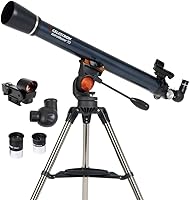
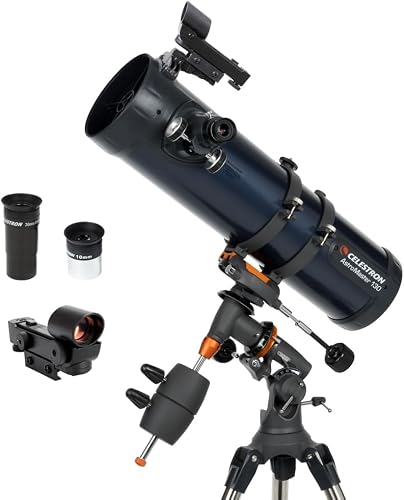
The AstroMaster includes a StarPointer red dot finder and 20mm and 10mm eyepieces; the PowerSeeker includes 20mm and 4mm eyepieces plus a 3x Barlow lens. Choose based on the accessories you expect to use, not on the number of possible magnification combinations.
The PowerSeeker's Barlow lens is designed to triple an eyepiece's power. It offers another way to change magnification, but pairing it with the 4mm eyepiece may produce more power than the sky conditions can support.
The AstroMaster's 20mm and 10mm eyepieces give you two starting options. Its 20mm eyepiece has a built-in erect image corrector, and the telescope comes with the StarPointer finder.
For either telescope, begin with the lower-power eyepiece and a bright, easy target. A steadier, wider view makes it easier to focus and center the object before you try a higher-power view.
For a plain explanation of eyepiece choices, see telescope eyepieces explained. That guide can help you understand what the included focal lengths mean for your observing plans.
Which is better for the Moon and planets?
Either model is described as suitable for the Moon and planets. The AstroMaster has a slightly larger aperture, while the PowerSeeker includes a 4mm eyepiece and a Barlow lens for higher magnification combinations.
The PowerSeeker's named targets include the Moon, Saturn's rings and Jupiter's Galilean moons. The AstroMaster's named targets include lunar craters, Saturn's rings and Jupiter's moons.
Those targets make sensible starting goals, but the view depends on focus, alignment and atmospheric conditions. Start with a low-power view, let the telescope adjust to outdoor temperatures, and increase magnification only while the image stays sharp.
For a first observing plan, use the Moon as a bright, easy target and move the focus slowly. Our guide to telescopes for Moon viewing covers what to look for and how to choose a useful view.
Which model makes more sense for deep-sky viewing?
Both are described for deep-sky viewing, but neither aperture difference guarantees a better view of every faint target. The PowerSeeker description names the Orion Nebula, and the AstroMaster description mentions Andromeda and other deep-sky objects.
A darker observing site can reveal more faint detail than a small difference in aperture. If you plan to view from a yard or city, choose brighter targets first and keep expectations realistic about faint galaxies and nebulae.
The different focal lengths also shape the view with each eyepiece. Consider whether your main interest is the Moon and planets, brighter deep-sky objects, or a mix, then select eyepieces that produce manageable magnification.
Is the PowerSeeker or AstroMaster easier to move?
The PowerSeeker weighs 13 lb, making it 4 lb lighter than the AstroMaster. That advantage matters if you carry the telescope from storage to the yard or load it for occasional trips.
Weight is only one part of portability. The PowerSeeker is described as compact and portable, while the AstroMaster is described as easy to move and set up in a backyard or dark-sky location.
Think about the whole route from storage to observing spot, including stairs, doorways and the tripod. If you expect regular travel, our portable telescope guide explains what else to consider beyond weight.
How should you set up either telescope?
Set up the tripod on firm, level ground, then assemble the mount and optical tube according to the instructions. Before observing, balance and align the equatorial mount, align the finder with the main telescope, and practice the controls.
The AstroMaster is described as assembling from a few key parts without tools. For either model, take your time with alignment: a finder that points away from the telescope makes every target harder to locate.
Practice before dark with a distant object that is safe to view. Center it in the main eyepiece, adjust the finder to match, and then repeat the process at night with a bright target.
Carry the telescope carefully and avoid touching the mirror surfaces. A Newtonian reflector may need a collimation check after transport or over time; our Newtonian collimation guide explains the process.
Who should buy the AstroMaster 130EQ?
Choose the AstroMaster if you want the named StarPointer red dot finder, a 20mm and 10mm eyepiece set, and the slightly larger aperture. It fits a beginner who plans to learn a German equatorial mount and does not mind the added carrying weight.
It is also the more straightforward pick if you want a specific finder design rather than an unspecified finderscope. The slow-motion knobs give you manual adjustments on both right ascension and declination.
Skip it if you expect to carry the telescope often and every pound matters. Its 17 lb weight is higher than the PowerSeeker's, and it does not include a Barlow lens.
Who should buy the PowerSeeker 127EQ?
Choose the PowerSeeker if lower weight and a 3x Barlow lens are more useful to you than the AstroMaster's red dot finder. At 13 lb, it is the lighter of the two options, and its package includes 20mm and 4mm eyepieces.
It suits a beginner who wants to experiment with eyepiece combinations and is willing to learn a manual equatorial mount. The 4mm eyepiece and Barlow combination is not automatically the best choice; use it only when the image remains sharp.
Skip it if you specifically want a red dot finder or prefer an eyepiece set without the short 4mm option. If you mainly want a quick, app-guided way to find targets, consider the StarSense Explorer instead.
Is the StarSense Explorer LT 114AZ a better beginner option?
Consider the StarSense Explorer LT 114AZ if guided target finding matters more than aperture or an equatorial mount. It weighs 10.4 lb, and its smartphone app uses sky recognition to guide you with on-screen arrows.
The mount is manual altazimuth with altitude slow-motion adjustment, and the telescope includes 25mm and 10mm eyepieces. Its 114mm aperture is smaller than either model in the main comparison.
This is the best fit of the three for someone who wants help locating objects and prefers a lighter setup. Choose the PowerSeeker or AstroMaster if you specifically want an equatorial mount.
What mistakes should you avoid with these telescopes?
Avoid starting with the highest magnification, skipping finder alignment, or expecting a manual mount to track for you. These common missteps can make an otherwise suitable telescope feel harder to use.
A 4mm eyepiece or a Barlow combination can make the target harder to keep in view and focus. Begin with a lower-power eyepiece, make small adjustments, and switch only when the image is steady and centered.
Do not assume that the 3mm aperture difference settles the decision. Finder preference, accessories and carrying weight are more practical differences for most beginners.
Finally, don't judge the telescope from a poorly aligned setup. Give yourself time to level the tripod, learn the mount motions and align the finder before deciding whether the experience suits you.
Which Celestron telescope should you choose?
For the Celestron PowerSeeker 127EQ vs AstroMaster 130EQ decision, pick the AstroMaster for its red dot finder and 20mm and 10mm eyepieces; pick the PowerSeeker for lower weight and the included Barlow lens. The StarSense Explorer LT 114AZ is the better fit if app guidance is your priority.
Choose the AstroMaster if you value its finder and slightly larger aperture more than easier carrying. Choose the PowerSeeker if you want to carry less and are comfortable choosing eyepieces carefully.
Before ordering, make sure an equatorial mount fits the kind of learning you want to do. For a broader comparison of telescope types and features, use our telescope buying guide.
Frequently asked questions
Which is better, the PowerSeeker 127EQ or AstroMaster 130EQ?
The AstroMaster 130EQ is the better fit if you want a named red dot finder and 20mm and 10mm eyepieces. The PowerSeeker 127EQ suits you if carrying less weight matters and you want a 3x Barlow lens.
Both are manual Newtonian reflectors on equatorial mounts, so expect to point and track targets yourself.
What is the main difference between these Celestron telescopes?
The AstroMaster 130EQ has a 130mm aperture, 650mm focal length and StarPointer red dot finder. The PowerSeeker 127EQ has a 127mm aperture, 1000mm focal length and includes a 3x Barlow lens.
Their eyepiece sets differ too: 20mm and 10mm for AstroMaster, 20mm and 4mm for PowerSeeker.
Are the PowerSeeker 127EQ and AstroMaster 130EQ easy for beginners?
Both are manual Newtonian reflectors with German equatorial mounts. You'll need to learn the mount, align the finder and track targets by hand.
The AstroMaster includes a StarPointer red dot finder, while the PowerSeeker includes a finderscope.
Read our telescope setup guide before your first session.
Which telescope is easier to carry?
The PowerSeeker 127EQ weighs 13 lb, compared with 17 lb for the AstroMaster 130EQ. The PowerSeeker is the lighter option, though the carrying distance and whether you move it assembled also matter.
Plan where you'll store it and how you'll get it to your observing spot.
Is the StarSense Explorer LT 114AZ a good alternative?
Consider the StarSense Explorer LT 114AZ if locating targets is your main concern. Its smartphone app uses sky recognition to guide you, and it weighs 10.4 lb.
Its 114mm aperture is smaller, and its manual altazimuth mount differs from the equatorial mounts on the PowerSeeker and AstroMaster.