How to Collimate a Newtonian Telescope
To collimate a Newtonian telescope, center the secondary mirror under the focuser, aim it at the primary mirror, then adjust the primary mirror so its center mark returns to the tool’s target. Make small changes and recheck each step.
On this page (8 sections)
- What does collimation do on a Newtonian telescope?
- What tools can you use to collimate a Newtonian?
- How do you check the secondary mirror?
- How do you adjust the primary mirror?
- How do you collimate with a laser collimator?
- What can throw a Newtonian telescope out of collimation?
- What should you do after collimating?
- When should you stop adjusting the mirrors?
To collimate a Newtonian telescope, center the secondary mirror under the focuser, aim it at the primary mirror, then adjust the primary mirror until its center mark aligns with your tool. Use a collimation cap, Cheshire tool, or laser collimator, and make only small changes.
Check alignment after moving the telescope and before observing when practical. A small shift can affect the optical path, so learn the checks before a session rather than adjusting by guesswork.
What does collimation do on a Newtonian telescope?
Collimation aligns the secondary and primary mirrors so they direct light along the focuser’s optical path. If they are out of alignment, stars may look less sharp, especially at higher magnification.
This is a mirror-alignment task, not a way to improve focus or compensate for a shaky mount. If you’re setting up a telescope for the first time, start with our guide to how to set up a telescope, then check its manual for the adjustment screw locations and names.
What tools can you use to collimate a Newtonian?
You can use a collimation cap, Cheshire tool, or laser collimator. A cap or Cheshire gives you a direct view through the focuser; a laser sends a beam through the optical path to help check alignment.
Choose a tool that fits your focuser and follow its instructions. A laser collimator also needs to be correctly aligned itself, so an inaccurate tool can lead you to adjust the telescope incorrectly.
Is a laser collimator useful for a beginner?
A laser can make primary-mirror checks easier to see, but its beam must be aligned and the tool must sit securely in the focuser. The SVBONY Laser Collimator has a removable 2 in adapter, 7 brightness levels, and a metal body.
The Astromania Laser Collimator fits standard 1.25 in focusers and has 7 brightness levels. Its instructions cover adjusting a Newtonian with the laser unit.
If you prefer a non-laser check, use a cap or Cheshire tool that fits your focuser. Whatever you choose, keep your telescope manual nearby and avoid forcing screws or accessories.
How do you check the secondary mirror?
Look through the focuser with the cap or Cheshire in place, and check that the secondary mirror appears centered beneath the focuser. The secondary should also show the primary mirror’s reflection in a way that lets you see the primary’s center mark.
If the secondary appears off-center, consult the telescope’s instructions before changing its position or tilt. Secondary adjustments can affect more than one part of the view, so turn the appropriate screws in small increments and inspect again.
A laser can help show whether the secondary is aiming at the primary’s center mark. Insert it gently and secure it as directed; a loose tool may point differently each time you check.
Should you adjust the secondary mirror every time?
No. Adjust the secondary only when the view shows it needs correction and you understand which screws control its position and tilt.
If the secondary already appears centered and aimed correctly, move on to the primary check.
How do you adjust the primary mirror?
Use the tool’s view to check whether the primary mirror’s center mark is aligned. With a laser, the beam should strike the primary center mark, and the return beam should align with the tool’s target or window according to its instructions.
Make a small adjustment to the primary mirror’s collimation screws, then check the tool again. If you’re unsure which screw to turn, stop and consult the manual instead of guessing.
Some telescopes have separate locking screws. Loosen them only as the manual describes, make the alignment change, and retighten gently if instructed.
Recheck alignment after tightening because that step can shift the mirror slightly.
What does a returning laser beam tell you?
A returning beam helps you check the primary mirror’s tilt, but it does not prove the whole telescope is collimated by itself. Confirm the secondary’s position and aim too, and make sure the laser collimator is seated securely and aligned.
How do you collimate with a laser collimator?
A laser collimator can show whether the beam reaches the primary’s center mark and returns to the tool’s target. Follow the collimator and telescope instructions, since tool designs and adjustment procedures vary.
- Place the telescope on a stable surface and remove the cap from the focuser.
- Insert the collimator gently and secure it as instructed.
- Check where the laser dot lands on the primary mirror.
- Make a small secondary adjustment only if the beam misses the center mark.
- Check the return beam and adjust the primary as directed.
- Recheck both mirrors after any adjustment.
Never look into the laser or point it toward anyone’s eyes. Keep the beam aimed only inside the telescope, and turn it off when you’ve finished checking.
What can throw a Newtonian telescope out of collimation?
Transport, bumps, and changes in how the telescope is positioned can shift alignment. Check the mirrors after a trip to a dark-sky site or if a sharp view becomes difficult to achieve.
A compact tabletop reflector can be easier to move and store. The Sky-Watcher Heritage 130 is a tabletop Dobsonian with a collapsible design and no assembly required.
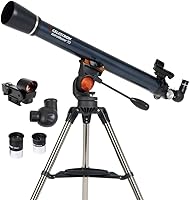
The Celestron AstroMaster 130EQ is a 130 mm Newtonian reflector on an equatorial mount. Its manual controls help you point the telescope, while collimation remains a separate mirror-alignment step.
After aligning the mirrors, check focus and the eyepiece before judging the view. Our guide to telescope eyepieces explains how eyepiece choice affects magnification and viewing.
What should you do after collimating?
After adjustment, recheck the secondary and primary mirror alignment, then point the telescope at a suitable target and focus carefully. If the image still looks soft, check that the telescope is steady and that the target is well placed in the sky.
Use a lower-power eyepiece first, then increase magnification only while the image remains clear. Our guide to calculating telescope magnification can help you understand how eyepiece and telescope focal lengths affect the view.
If you’re new to pointing a telescope, align its finder separately. See how to set up and align a red dot finder before searching for targets.
When should you stop adjusting the mirrors?
Stop when the checks in your tool’s instructions show the mirrors aligned. Repeated large turns can make alignment harder, so use small changes and recheck after each one.
If the secondary looks badly out of place, a screw feels stuck, or you can’t tell which adjustment controls the mirror, consult the telescope manual or a local astronomy group. For a Newtonian telescope, collimate by checking the secondary first and the primary second, then leave the screws alone once the alignment holds.
Frequently asked questions
How often should you collimate a Newtonian telescope?
Check collimation before observing, especially after transport or a bump, because movement can shift mirror alignment. You may not need to adjust anything each time.
If the secondary and primary mirror checks remain centered, leave the adjustment screws alone.
Can you collimate a Newtonian telescope without a laser?
Yes. A collimation cap or Cheshire tool can help you check the mirrors without a laser.
Follow the tool instructions and your telescope manual, since the view and adjustment steps vary by tool and scope design.
Which mirror do you adjust first when collimating?
Check the secondary mirror first, then adjust the primary mirror. The secondary must be positioned and aimed correctly before the primary’s reflection can be aligned.
Make small adjustments and recheck both mirrors after each change.
Does collimation make every telescope image sharper?
Correct collimation helps a Newtonian reflector reach the image quality its optics can provide, but it cannot correct poor focus, shaky support, atmospheric blur, or a target that is too low. Check those factors if the view remains soft after alignment.