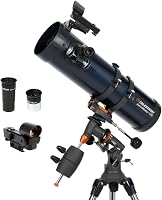
Telescope Buying Guide for Adults and Families
Choose a telescope with enough aperture for your targets and a steady setup you can carry and use often. This telescope buying guide helps you compare mounts, optics, portability and guidance for adults and families.
On this page (11 sections)
- What should a telescope buying guide help you decide?
- What can you see through a telescope?
- How much aperture do you need?
- Should you choose a refractor or reflector?
- Which telescope mount is right for you?
- Should your first telescope have a phone app?
- How should adults and families think about portability?
- What accessories are useful for a beginner?
- How much should you spend on a first telescope?
- What should you check before buying?
- Which telescope should you buy?
Choose a telescope with enough aperture for your targets and a steady setup you can carry and use often. This telescope buying guide helps you compare mounts, optics, portability and guidance for adults and families.
A telescope does not remove clouds, city glow or shaky support. Decide where it will live and how it will get outside before narrowing down models.
For a quick shortlist, compare an app-guided reflector, a tabletop Dobsonian, a small travel refractor and a larger refractor:
If you already know you want a beginner-friendly pick, see our best telescope for beginners guide. The sections below help you make that choice from your own observing habits.
What should a telescope buying guide help you decide?
A telescope buying guide should help you choose a scope you can set up and use for your targets. The key decisions are aperture, optical design, mount, guidance, portability and accessories.
Start with these questions:
| Question | Why it matters |
|---|---|
| What do you most want to see? | The Moon, planets and star clusters place different demands on aperture and location. |
| Where will you observe? | A balcony, yard, campsite and dark-sky trip have different space and transport needs. |
| Who will use the telescope? | Children and adults may need different eyepiece heights and adjustment effort. |
| How will you find targets? | A phone app can guide you, while an unguided setup asks you to learn the sky. |
| Where will it be stored? | Tube length, tripod size and base shape affect whether you can keep it ready. |
Use your answers to set a few practical limits. For example, you might need a telescope that fits in a closet, can be carried by one adult and works on a patio table.
Then compare models that fit those limits. A long list of accessories is less useful if the telescope is hard to keep steady or inconvenient to carry.
What can you see through a telescope?
A telescope can show the Moon’s craters, bright planets and some deep-sky objects, but the view depends on aperture, sky conditions and what is above your horizon. Do not choose based on a promise of dramatic views of every target.
The Moon is a common first target because it is bright and easy to locate. Jupiter and Saturn can also be rewarding when visible, though the amount of detail depends on the telescope, atmosphere and observing conditions.
Nebulae, galaxies and star clusters are other possible targets. Many of these objects look faint to the eye, especially under city light, so a darker observing location can matter as much as a feature on the tube.
Think about whether you want to observe at home or travel for darker skies. If you mainly observe from a city, read can you use a telescope in the city? before deciding what targets to expect.
How much aperture do you need?
Choose aperture around your targets and the setup you can manage. Aperture is the diameter of the main lens or mirror, and a larger opening gathers more light but still needs stable support.
The products in this guide show how aperture and design can vary:
| Example | Aperture | Basic design | Practical point |
|---|---|---|---|
| Celestron StarSense Explorer LT 114AZ | 114mm | Newtonian reflector | Phone guidance and a manual alt-azimuth mount |
| Sky-Watcher Heritage 150 Tabletop Dobsonian | 150mm | Tabletop Dobsonian reflector | Larger mirror and collapsible tube |
| Celestron Travel Scope 70 | 70mm | Refractor | Compact travel kit with a backpack |
| MEEZAA 90mm Refractor | 90mm | Refractor | 800mm focal length, tripod and carry bag |
These sizes are examples, not a promise that one model suits every observer. Compare the telescope with its full support system, because a larger tube or base may need more storage and a stronger surface.
Do not treat advertised magnification as the main measure of quality. A high number cannot make an unstable mount steady or improve a hazy sky.
Should you choose a refractor or reflector?
Choose a refractor if you prefer a lens-based telescope, or compare reflectors if a larger mirror suits your targets. The better fit depends on storage, handling and how much setup you are willing to learn.
A refractor uses lenses at the front of the tube. The Celestron Travel Scope 70 is a 70mm refractor with a preassembled mount and tripod, 20mm and 10mm eyepieces, and a 45° erect-image diagonal.
A reflector uses a primary mirror. The Celestron StarSense Explorer LT 114AZ has a 114mm mirror, while the Sky-Watcher Heritage 150 Tabletop Dobsonian has a 150mm mirror and a collapsible tube.
Each design has trade-offs in size, handling and maintenance. For a fuller comparison, see Dobsonian vs refractor telescopes for beginners.
Is a refractor a simple telescope buying guide choice?
A refractor can suit beginners who prefer a lens-based telescope, but setup and storage still vary by model. The Celestron Travel Scope 70 needs no tools for setup, and its backpack holds the telescope and accessories.
A short setup does not remove the need to check that the mount and tripod feel stable. Keep lenses capped during storage and follow the brand’s care instructions.
Does a reflector need collimation?
A Newtonian reflector needs correctly aligned mirrors for clear views. Learn how to check that alignment, called collimation, and follow the model’s instructions for any adjustments.
Our Newtonian telescope collimation guide explains the basic process. Factor that learning step into your choice rather than assuming every reflector needs the same adjustment schedule.
Which telescope mount is right for you?
Choose a mount that holds the telescope steadily and lets you point it easily. All 4 examples here use alt-azimuth mounts, which move up and down and side to side.
An alt-azimuth mount offers a straightforward way to point across the sky. It can be a practical match for family observing, where several people take turns at the eyepiece.
Tabletop Dobsonians need a firm, level surface. The Sky-Watcher Heritage 150 Tabletop Dobsonian has rubber feet; plan for a sturdy table or other support at a comfortable height.
Tripod models can work where a table is not available, but a tall tripod may move when touched. Set it on firm ground, tighten its adjustments as directed and avoid extending it more than needed.
Equatorial mounts can help follow objects across the sky once correctly aligned. They add a learning step, so compare them with simpler alt-azimuth choices in our equatorial vs alt-azimuth mount guide.
Should your first telescope have a phone app?
A phone-guided telescope can help you locate targets, while an unguided telescope lets you practice finding them yourself. Choose based on whether you value guided searching or an app-free routine.
The Celestron StarSense Explorer LT 114AZ uses its app to analyze star patterns and show arrows toward selected targets. It also generates a target list based on your time and location.
You still move this telescope by hand; the app does not point or track it with motors. Check phone compatibility and whether you are comfortable using a screen outdoors before choosing it for guidance.
An unguided scope avoids app setup, though locating objects may take more practice. That can matter if you have not yet learned the constellations.
For either type, begin with easy targets and learn how the finder and eyepiece work. Our telescope setup guide walks through first-use steps.
How should adults and families think about portability?
Judge portability by weight, packed size and the support you need at your destination. Consider how many pieces you will carry and whether you have a secure place to set them down.
The Celestron Travel Scope 70 weighs 4.2 lb and includes a backpack. That can suit a family that wants to carry equipment to a campsite or store it in a small space.
The Sky-Watcher Heritage 150 Tabletop Dobsonian has a collapsible tube for storage and transport and weighs 23 lb. Its tabletop base also needs stable support, so account for that at your observing spot.
For a tripod model, consider how you will pack the tube, tripod and accessories. Adults should handle setup around young children, then supervise their turns at the eyepiece.
If you expect to carry the telescope often, compare options in our portable telescope guide. A slightly smaller scope that comes out regularly can be more useful than a large one that is awkward to move.
What accessories are useful for a beginner?
Useful accessories include eyepieces, a finder and a way to carry your equipment. Check what comes with the telescope before buying extras.
The 4 examples here include different combinations:
- The Celestron StarSense Explorer LT 114AZ includes 25mm and 10mm eyepieces, a 2x Barlow lens, a StarPointer finderscope and a phone dock.
- The Sky-Watcher Heritage 150 Tabletop Dobsonian has a 1.25-inch helical focuser and a reflex finder.
- The Celestron Travel Scope 70 includes 20mm and 10mm eyepieces, a finderscope, a star diagonal and a backpack.
- The MEEZAA 90mm Refractor includes 10mm and 25mm eyepieces, a 3x Barlow lens, a phone adapter and a carry bag.
An included phone adapter can help position a smartphone for photos, but taking clear telescope images can require practice. Start by learning to observe through the eyepiece before spending more on imaging gear.
Higher magnification is not automatically better. Learn what each eyepiece does in our telescope eyepieces guide.
How much should you spend on a first telescope?
Set a budget for the complete setup you need, including stable support and any missing accessories. Avoid stretching your budget for a larger aperture if the telescope will be difficult to store or use.
Compare total cost after identifying the features that matter to you. A carry case, phone guidance or a larger mirror may be worth paying more for if it solves a real problem in your routine.
Avoid choosing from a large magnification number or dramatic images alone. Consider the mount, assembly, storage and the objects you can reasonably see from your observing location.
Our guide to buying a telescope offers another path through the main buying decisions. Use it alongside the checklist below to narrow your options.
What should you check before buying?
Before buying, confirm that the telescope fits your space, transport plan and observing habits. Use this checklist to catch common mismatches:
- Name your main targets, such as the Moon, planets or bright deep-sky objects.
- Decide whether you will observe from a yard, balcony, campsite or darker location.
- Measure the storage space and check the tube, tripod or base dimensions.
- Consider who will carry the setup and who will assemble it.
- Compare mount stability and how easily you can point the telescope.
- Check phone compatibility if the model uses an app.
- Read the included-accessory list and identify any real gaps.
- Learn whether the optical design calls for alignment or other care.
After the telescope arrives, assemble it in daylight and practice focusing on a distant land target well away from the Sun. Never point a telescope or finder at the Sun without a proper solar filter system and instructions for that equipment.
Then try the Moon or another easy night-sky target when conditions are suitable. Keep children supervised during both daytime practice and night viewing.
Which telescope should you buy?
Use this telescope buying guide to choose for your most likely observing routine. Pick phone guidance for help finding targets, a tabletop Dobsonian for its larger mirror, or a travel refractor for simpler packing.
For adults and families who want app guidance, consider the Celestron StarSense Explorer LT 114AZ. If you want a 150mm mirror and have sturdy support, consider the Sky-Watcher Heritage 150 Tabletop Dobsonian.
For trips, the Celestron Travel Scope 70 includes a backpack. Choose the MEEZAA 90mm Refractor if you prefer a 90mm lens and want a phone adapter and carry bag in the kit.
After choosing, read how to set up a telescope for the first time to plan your first session.
Frequently asked questions
What should I look for when buying a telescope?
Look for aperture suited to your targets, stable support and a setup you can carry outside often. Compare storage size, assembly, guidance tools and included accessories, since a steady telescope that is easy to use can be a better fit than a larger one that stays packed away.
What is a good first telescope for an adult?
A good first telescope for an adult has a manageable setup, a steady mount and enough aperture for the targets that interest you. A smartphone-guided model can help you locate objects, while a tabletop Dobsonian offers a larger mirror in a collapsible tube that still needs firm support.
Can a family share one telescope?
Yes, a family can share a telescope if the eyepiece is within comfortable reach and adults supervise setup and use. A simple manual mount lets each person take a turn, while phone guidance can help new observers locate targets without needing to learn the sky first.
Is a bigger telescope always better?
No, a larger aperture gathers more light, but the full telescope may also take more room and effort to move. Compare the tube, base or tripod and storage needs, then choose a size you can set up steadily and use under the skies available to you.
Do I need a telescope with a computer or app?
No, a manual telescope can work well if you are willing to learn how to find targets. An app-guided telescope can reduce the search work by suggesting objects and showing where to point, but guidance still needs to be paired with stable support and clear setup instructions.