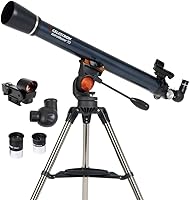
How to Calculate Telescope Magnification
To calculate telescope magnification, divide the telescope’s focal length by the eyepiece’s focal length. A 1,000 mm telescope with a 10 mm eyepiece gives 100×, though the clearest useful power depends on the target and conditions.
On this page (8 sections)
- How do you calculate telescope magnification?
- Where can you find the focal lengths?
- How does eyepiece focal length change the view?
- How much magnification is useful?
- Why can high magnification look worse?
- How do you choose an eyepiece for a target?
- What mistakes should you avoid when calculating magnification?
- What is the best way to calculate and use magnification?
To calculate telescope magnification, divide the telescope’s focal length by the eyepiece’s focal length. A 1,000 mm telescope with a 10 mm eyepiece gives 100×, but your clearest useful setting depends on the target, aperture, focus, and steadiness of the sky.
The calculation tells you how large an object appears through a telescope. It does not tell you whether that view will be bright, sharp, or easy to keep centered.
Start with the formula, then choose an eyepiece based on what you want to see and how steady the image looks.
How do you calculate telescope magnification?
Telescope magnification equals telescope focal length ÷ eyepiece focal length. Use the same units, usually millimeters, for both numbers.
For a 900 mm telescope and a 10 mm eyepiece, divide 900 by 10. The result is 90×.
With a 25 mm eyepiece, the same telescope gives 36×, so the 10 mm eyepiece produces a more enlarged view.
A shorter eyepiece focal length increases magnification because it is the divisor. A longer one reduces magnification and is usually a better starting point when you need to find an object or view a wider stretch of sky.
How do you calculate telescope magnification with a Barlow?
Multiply the eyepiece result by the Barlow factor. A 2× Barlow doubles the magnification: 90× becomes 180×.
A Barlow lens fits between the telescope and eyepiece. For example, a 900 mm telescope with a 25 mm eyepiece gives 36× without a Barlow and 72× with a 2× Barlow.
That combination gives the same magnification as a 12.5 mm eyepiece in that telescope.
The Celestron Omni 2X Barlow Lens fits 1.25 in focusers and diagonals and accepts 1.25 in eyepieces. Its fully multi-coated optics and blackened edges are intended to limit reflections while transmitting light.
Choose this Barlow if you already own compatible eyepieces and want more magnification options without replacing them. Skip it if your telescope or eyepieces use a different barrel size, or if your current eyepiece already produces more power than the sky conditions support.
Where can you find the focal lengths?
Find the telescope’s focal length in its manual or specifications, and look for the eyepiece focal length on the eyepiece barrel. Both figures are commonly printed in millimeters.
The telescope’s focal length belongs to its optical tube. Don’t confuse it with aperture, which is the diameter of the telescope’s main lens or mirror.
If the manual is missing, search the manufacturer’s support information using the exact model name.
For example, the Celestron StarSense Explorer LT 114AZ has a 1,000 mm focal length and comes with 10 mm and 25 mm eyepieces. Those combinations give 100× and 40×.
Its smartphone-guided app and manual altazimuth mount help beginners locate targets, while the 114 mm reflector suits someone who wants to observe the Moon, planets, and brighter deep-sky objects.
This telescope is a fit if guided target finding and a manual mount match how you want to observe. Skip it if you want a telescope with a motorized mount or prefer a setup without a smartphone app.
For a smooth first session, follow how to set up a telescope for the first time.
How does eyepiece focal length change the view?
A shorter eyepiece focal length gives higher magnification in the same telescope. A longer focal length gives lower magnification and, with similar eyepiece designs, typically shows more sky at once.
Here is the calculation for a 1,000 mm telescope:
| Eyepiece focal length | Magnification |
|---|---|
| 20 mm | 50× |
| 10 mm | 100× |
| 4 mm | 250× |
These numbers describe image scale, not guaranteed clarity. A 4 mm eyepiece may enlarge the target considerably, but that power can be difficult to use if the image appears dim, wavers, or loses detail.
The 4 mm, 10 mm, and 20 mm Eyepiece Set gives three focal lengths to compare. Its soft eyecups provide a comfortable contact point when your eye is close to the eyepiece.
Pick this set if your telescope accepts 1.25 in eyepieces and you want several focal lengths in one kit. Skip it if you already have eyepieces that cover those focal lengths or need a Barlow lens included.
For more on choosing an eyepiece, see telescope eyepieces explained for beginners.
How much magnification is useful?
A telescope has a practical magnification limit, beyond which extra power shows little useful detail. Aperture, optical quality, focus, the target, and atmospheric steadiness all affect how much magnification works.
A common rule of thumb estimates about 50× per inch of aperture under good conditions. Treat that as a rough ceiling rather than a setting to aim for every night.
Atmospheric turbulence can blur a planet even when the telescope and eyepiece could theoretically support more power.
For a 114 mm telescope, which is about 4.5 in across, the rule suggests a rough upper estimate near 225×. That does not mean 225× will be clear on every target or observing night.
The included 100× and 40× eyepiece combinations on the StarSense Explorer LT 114AZ offer more practical starting points.
Try a lower-power eyepiece when the image looks dim, shaky, or soft. The guide to what you can see with a 70 mm telescope can help set expectations for what aperture reveals.
Why can high magnification look worse?
High magnification can make an object larger while making its details harder to see. It spreads the light from extended targets such as the Moon and planets across a larger apparent area, and it makes atmospheric blur and small movements more noticeable.
Begin with the longest-focal-length eyepiece you have. Center the target, focus carefully, then switch to a shorter eyepiece or add a Barlow and check whether the view still looks sharp.
The Astromania Plossl Eyepiece Set includes 4 mm, 10 mm, and 25 mm eyepieces with a 2× Barlow. The eyepieces have a 50-degree apparent field of view, fully multi-coated optics, and filter threads for standard 1.25 in filters.
Choose this kit if you want several focal lengths and a Barlow together, especially for comparing views of the Moon or planets. Skip it if you want only one eyepiece, or if your telescope cannot accept 1.25 in accessories.
If a higher-power view loses detail, return to the previous eyepiece combination.
How do you choose an eyepiece for a target?
Use the lowest power that frames the target well, then increase magnification only while the image stays clear. The Moon, planets, and wide star fields call for different balances of image size and viewing area.
For a wide star field, start with a longer focal length eyepiece. For the Moon or a planet, try a shorter focal length once the object is centered and focused.
If the sky is unsteady, a lower-power view often shows more detail than a larger but blurred image.
Higher magnification also reduces the amount of sky visible in the eyepiece. With a manual mount, that can make an object harder to keep centered as it moves across the view.
Move the telescope gently and refocus after changing eyepieces.
What mistakes should you avoid when calculating magnification?
The most common mistakes are using aperture instead of telescope focal length, mixing units, and treating the highest possible number as the best choice. Check that both focal lengths use the same units before dividing.
Don’t assume that every eyepiece or Barlow will fit every telescope. Check the barrel size, and confirm that the eyepiece seats securely before observing.
Change accessories carefully, keeping dust off the exposed lenses and avoiding fingerprints on the glass.
Don’t judge a new combination while the telescope is still shaking or out of focus. Let the mount settle after you touch it, focus on the target again, and lower the power if the image remains soft.
What is the best way to calculate and use magnification?
To calculate telescope magnification, divide the telescope’s focal length by the eyepiece’s focal length, then multiply by the Barlow factor if you use one. Start low, center and focus the target, and stop increasing power when the image loses clarity.
Pick the Celestron Barlow if you already have compatible eyepieces and want to double their magnification. Choose the 4 mm, 10 mm, and 20 mm set for three focal lengths, or the Astromania kit if you also want a Barlow in the same set.
For broader buying decisions, use the telescope buying guide for adults and families.
Frequently asked questions
How do I calculate telescope magnification?
Divide the telescope’s focal length by the eyepiece’s focal length, using the same units for both. A 900 mm telescope with a 10 mm eyepiece gives 90× magnification.
If you add a 2× Barlow lens, multiply 90 by 2 for 180×.
Does a shorter eyepiece give more magnification?
Yes. In the same telescope, a 5 mm eyepiece gives twice the magnification of a 10 mm eyepiece because the shorter focal length is the divisor.
The larger view may be dimmer or less steady, so use the power only while details remain clear.
How do I calculate magnification with a Barlow lens?
First divide telescope focal length by eyepiece focal length, then multiply by the Barlow factor. A 1,000 mm telescope and 10 mm eyepiece give 100×; a 2× Barlow raises that combination to 200×.
Is higher magnification always better?
No. Higher power enlarges the view, but it can also make the image dimmer and magnify blur from the atmosphere, poor focus, or movement.
Start with a longer focal length eyepiece, center the object, and increase power only while it stays sharp.