Telescope Eyepieces Explained for Beginners
Telescope eyepieces set magnification and how much sky you see. Start with a longer focal length for finding targets, then switch to a shorter one when the image stays clear and steady.
On this page (8 sections)
- What do telescope eyepieces change?
- How does eyepiece focal length affect magnification?
- Which telescope eyepieces suit the Moon and planets?
- Which eyepiece works best for wider views?
- How should you choose between eyepieces and sets?
- What do field of view and eye relief mean?
- How do you change and care for an eyepiece?
- Which telescope eyepieces should a beginner choose?
Telescope eyepieces set magnification and how much sky fits in your view. Start with a longer focal length for an easier, wider view, then use a shorter one for more detail when the image remains sharp.
The right first buy depends on your telescope’s focuser size, focal length, and the targets you want to see. A kit can cover several magnifications, while a single low-power eyepiece may be enough if you already have a useful high-power option.
What do telescope eyepieces change?
A telescope eyepiece magnifies the image formed by the telescope. Its focal length, measured in millimeters, helps determine magnification, while its apparent field of view affects how wide the view seems.
Eyepieces also vary in eye relief and barrel size. These shape viewing comfort and fit, so check the telescope manual before choosing an accessory.
If you're still choosing an instrument, our telescope buying guide for adults and families explains the main telescope types and features. For a first look through your telescope, the setup guide covers assembly and alignment.
How does eyepiece focal length affect magnification?
A shorter eyepiece focal length gives higher magnification in the same telescope. Divide the telescope’s focal length by the eyepiece’s focal length to calculate the magnification.
For example, a telescope with a 900 mm focal length gives 36x with a 25 mm eyepiece and 90x with a 10 mm eyepiece. The telescope’s focal length is usually printed in its manual or product specifications.
Our guide to calculating telescope magnification walks through the formula and explains how a Barlow lens changes the result. Treat the calculation as a starting point: air movement, focus, and aperture can limit useful detail.
How do telescope eyepieces work with a 2x Barlow?
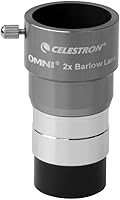
A 2x Barlow doubles an eyepiece’s magnification. In a 900 mm telescope, a 25 mm eyepiece gives 36x on its own and 72x with a 2x Barlow.
The Astromania set includes 4 mm, 10 mm, and 25 mm Plossl eyepieces, plus a 2x Barlow. Choose it if you want several focal lengths in one set and your focuser accepts 1.25 inch accessories.
Skip the set if you mainly need a longer focal length for easier target finding, or if you already own comparable eyepieces. The 4 mm option produces high magnification, which may be too much for some telescopes and observing conditions.
A Barlow adds magnification, but it doesn’t add light or detail. Find and focus the target with the eyepiece alone before adding the Barlow.
Which telescope eyepieces suit the Moon and planets?
Use as much magnification as keeps the target clear, bright, and steady. The Moon and planets often reward a closer view, but the right power depends on the telescope and the atmosphere.
Find the target at lower power, center it, then try a shorter focal length and refocus. Stop when the image grows soft, dim, or shaky.
The Celestron kit suits beginners who want several focal lengths in one purchase. It includes five 1.25 inch Plossl eyepieces from 6 mm to 32 mm, a 2x Barlow, a Moon filter, and colored filters.
Choose this kit if you need both eyepieces and filters and want the foam-lined case to keep accessories together. Skip it if you only need one eyepiece, already have a useful range, or your telescope does not accept 1.25 inch accessories.
Colored filters change the light reaching your eye and may bring out some planetary features. Follow the telescope and filter instructions, and remove a filter if the view becomes too dim.
For lunar observing, see our guide to Moon filters for telescopes. A Moon filter is not a solar filter.
Which eyepiece works best for wider views?
Choose a longer focal length for lower magnification and a broader view. That makes a long-focal-length eyepiece useful for finding objects and viewing wider star fields.
The SVBONY SV131 is a 25 mm Plossl with a 48-degree field of view. Its standard 1.25 inch barrel fits a 1.25 inch focuser, and its eyecup folds down for glasses.
Choose this eyepiece if you already have other focal lengths and want a single low-power option. Skip it if you need a full set or a shorter focal length for higher magnification.
A wider apparent field can make a view feel more expansive, but it does not change magnification. The mount also affects how easily you can keep a target in view.
How should you choose between eyepieces and sets?
Match the barrel first, then choose focal lengths that fill gaps in your current setup. A useful range gives you low, medium, and higher power, with the lower-power option ready for locating targets.
The starboosa set includes 20 mm, 10 mm, and 4 mm eyepieces for 1.25 inch telescopes. Choose it if you want three focal lengths in one set and your focuser accepts that barrel size.
Skip this set if your telescope’s focuser is a different size or if the 4 mm eyepiece would push magnification beyond what you can use. Start with 20 mm, focus, then move to shorter focal lengths only while the view stays sharp.
If you already have a range of eyepieces, the SVBONY 25 mm is a simpler single addition. Choose the Astromania set for its three Plossl focal lengths and Barlow, or the Celestron kit if filters are also on your list.
What do field of view and eye relief mean?
Field of view describes the apparent width of the view, and eye relief describes how far your eye can sit from the eyepiece. These affect comfort and framing, but neither replaces checking magnification or fit.
If you wear glasses, look for enough eye relief to see the full field without pressing your glasses against the eyepiece. Fold-down rubber eyecups can make that easier.
A larger apparent field may help a moving target stay in view longer, depending on the telescope and mount. Compare the field of view and eye relief when choosing between similar focal lengths.
How do you change and care for an eyepiece?
Start at low power, center the target, focus, and then change eyepieces if you want more magnification. Secure the focuser and telescope before removing an eyepiece.
Keep dust caps on unused eyepieces and hold them by the barrel. Avoid touching the glass, and follow the care instructions for your telescope and accessories.
If you have trouble locating a target, a properly aligned red dot finder can help you point the telescope. Recheck focus after each eyepiece change because the new focal length may need a different focuser position.
Which telescope eyepieces should a beginner choose?
Choose the eyepiece that fills a gap in your current setup. Pick the Celestron kit if you need a broad range plus filters, the Astromania set if you want three Plossl focal lengths with a Barlow, or the SVBONY 25 mm if one lower-power eyepiece is enough.
The 20 mm, 10 mm, and 4 mm set is another option for a 1.25 inch focuser, though its shortest focal length may be too powerful for some setups. Check fit first, begin with the longest focal length, and let the clarity of the view guide your next change.
Frequently asked questions
What eyepiece should a beginner use first?
Start with the eyepiece with the longest focal length, which gives lower magnification in the same telescope. A lower-power view is usually easier for locating an object and keeping it in view.
Once centered, try a shorter focal length if the image remains sharp and steady.
Does a shorter eyepiece give more magnification?
Yes. In the same telescope, a shorter eyepiece focal length gives more magnification.
Divide the telescope's focal length by the eyepiece's focal length to calculate it; for example, a 900 mm telescope with a 10 mm eyepiece gives 90x magnification.
Can I use any eyepiece with my telescope?
No. Check that the eyepiece barrel matches the telescope focuser, commonly 1.25 inches or 2 inches, and confirm that the eyepiece can reach focus in your telescope.
A compatible barrel is a useful first check, but it doesn't guarantee every eyepiece will suit every telescope.
What does a Barlow lens do?
A Barlow lens increases magnification by extending the effective focal length of the telescope. A 2x Barlow doubles the magnification of an eyepiece, but it can't add detail when the atmosphere, focus, or telescope limits the view.
Try it after getting a clear view without it.