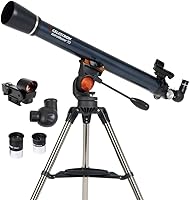
8 Best Telescopes for Moon Viewing (November 2026)
The best telescopes for viewing the Moon include the Celestron StarSense Explorer LT 114AZ for guided lunar sessions, the Sky-Watcher Heritage 130 Tabletop Dobsonian for tabletop aperture, and the Celestron StarSense Explorer LT 80AZ for guided family viewing.
On this page (7 sections)
- Which telescope for moon viewing fits your needs?
- What should you compare before choosing a lunar telescope?
- What is the best magnification for viewing the Moon?
- When is the Moon easiest to study?
- Do you need a moon filter for a telescope?
- How do you make a telescope session easier?
- Which telescope for moon viewing should you choose?
The Celestron StarSense Explorer LT 114AZ is the best telescope for moon viewing for most beginners because its 114mm reflector pairs useful aperture with phone-guided target finding. Choose the Heritage 130 for a larger tabletop scope, or the Travel Scope 70 if a backpack and lighter setup matter more.
The Moon is a rewarding first target because it is bright, easy to recognize and changes appearance through the month. You do not need a complicated mount, but a steady support and comfortable way to aim make each session easier.
For a broader overview of setup and optics, see our telescope buying guide for adults and families. If you're new to assembly, our first-time telescope setup guide walks through the initial steps.
Our picks at a glance
-
1
 Best for guided lunar sessions
Celestron StarSense Explorer LT 114AZ
8.8/10 our score
See it on Amazon -
2
 Best for tabletop aperture
Sky-Watcher Heritage 130 Tabletop Dobsonian
8.5/10 our score
See it on Amazon -
3
 Best for guided family viewing
Celestron StarSense Explorer LT 80AZ
8.4/10 our score
See it on Amazon
Which telescope for moon viewing fits your needs?
The best telescope for moon viewing depends on how much aperture you want, where you'll set it up and whether you want help finding the target. These picks range from phone-guided scopes to compact tabletop designs and travel kits.
Celestron StarSense Explorer LT 114AZ: Best for guided lunar sessions
- 114mm Newtonian reflector
- Phone-guided sky tours
- Manual altazimuth mount
- 25mm and 10mm eyepieces
The 114mm reflector pairs a larger aperture with StarSense phone guidance. It suits beginners who want help locating the Moon and other sky targets.
Pros
- Phone-guided target finding
- Two included eyepieces
- Altitude slow-motion adjustment
Cons
- Needs a compatible smartphone for app guidance
- Reflector design may need collimation
The LT 114AZ is the strongest all-around pick here for a beginner who wants both lunar views and guidance across the night sky. Its 114mm Newtonian reflector has the largest aperture among the full-height guided models in this roundup.
StarSense uses a phone dock and sky recognition to point you toward selected targets. Follow the app arrows, then center the Moon in the eyepiece; the manual altazimuth mount includes an altitude slow-motion adjustment for small corrections.
Two eyepieces, 25mm and 10mm, give you different views to try. Start with the wider view to find and center the Moon, then switch eyepieces to frame it more tightly.
This telescope makes sense if phone guidance matters and you want a scope for other targets too. Like any reflector, it may need collimation from time to time, so read our guide to collimating a Newtonian telescope if you choose it.
Sky-Watcher Heritage 130 Tabletop Dobsonian: Best for tabletop aperture
- 130mm aperture
- Tabletop Dobsonian design
- Collapsible optical tube
- 10mm and 25mm eyepieces
This 130mm tabletop Dobsonian brings substantial aperture in a compact package. It works best when you have a steady table or other firm surface.
Pros
- Largest aperture in this group
- Fully assembled
- Includes two eyepieces and a starpointer
Cons
- Requires a stable raised surface
- Less convenient for standing use
The Heritage 130 gives you the largest aperture in this group, at 130mm, in a tabletop Dobsonian format. That extra aperture is a useful fit for observers who have a firm table or platform ready.
It comes fully assembled with 10mm and 25mm eyepieces and a starpointer finder. The compact package combines its base and optical tube, and the tube collapses for storage and transport.
The tabletop design keeps setup simple, but it changes how you observe. You'll need a surface at a comfortable height, and the scope is less convenient if you expect to stand and move around during a session.
Choose it if aperture is your priority and a sturdy support is available. If you want a full-height tripod instead, compare it with the Celestron AstroMaster 70AZ, which has manual panhandle controls.
Celestron StarSense Explorer LT 80AZ: Best for guided family viewing
- 80mm refractor
- Phone-guided sky tours
- Manual altazimuth mount
- 25mm and 10mm eyepieces
The 80mm refractor includes StarSense phone guidance and a full-height tripod. It suits families who want a guided way to find the Moon.
Pros
- Phone-guided target finding
- Two eyepieces included
- Erect image diagonal
Cons
- Smaller aperture than the reflector picks
- Phone guidance needs a compatible device
The LT 80AZ combines an 80mm refractor with the same basic StarSense phone-guided approach as the LT 114AZ. It is a good family option when simple target finding matters more than choosing the biggest aperture.
The app generates suggested targets for your location and time, then guides you with on-screen arrows. Its manual altazimuth mount includes an altitude slow-motion adjustment, and the included tripod is full height.
The 25mm eyepiece gives a wider starting view for finding the Moon, while the 10mm eyepiece brings a closer framing. An erect image diagonal is also included, which supports daytime viewing as well as night use.
Pick this model if you want guided aiming in a refractor package. For a simple explanation of how eyepiece choice changes the view, read telescope eyepieces explained.
Celestron Travel Scope 70: Best for travel sessions

- 70mm refractor
- Included backpack
- No-tool setup
- 20mm and 10mm eyepieces
The 70mm refractor packs into an included backpack and sets up without tools. It's a practical choice when portability matters more than aperture.
Pros
- Lightweight at 4.2 lb
- Backpack included
- Usable for daytime scenery too
Cons
- Smallest aperture among the main refractor picks
- Tripod and mount are included but basic
The Travel Scope 70 is the easiest pick here to carry away from home. It weighs 4.2 lb and includes a backpack for the telescope and accessories.
Its 70mm refractor has fully coated glass lenses and comes with 20mm and 10mm eyepieces. The no-tool setup and full-height tripod suit quick sessions at a campsite, in a backyard or on a trip.
The smaller aperture trades some light gathering for portability. It can still show lunar craters and other major features, but observers who want a larger aperture should look at the Heritage 130 or LT 114AZ.
Choose it when packing and easy transport are central to your plans. Our guide to what you can see with a 70mm telescope explains the limits and strengths of that aperture.
Celestron AstroMaster 70AZ: Best for straightforward pointing

- 70mm refractor
- Manual panhandle altazimuth mount
- 20mm and 10mm eyepieces
- StarPointer red dot finder
The 70AZ uses a simple panhandle mount and includes a red dot finder. It suits new observers who prefer direct manual pointing.
Pros
- Easy manual controls
- Two eyepieces included
- Day and night viewing
Cons
- 70mm aperture limits light gathering
- Tripod setup takes more space than a tabletop scope
The AstroMaster 70AZ is a straightforward refractor for someone who wants to point manually without using a phone app. Its panhandle altazimuth mount moves up, down and side to side with simple controls.
The 70mm optics come with 20mm and 10mm eyepieces, an erect image diagonal and a StarPointer red dot finder. The adjustable tripod can be used standing or seated, which is handy when more than one person is taking turns.
This is a familiar style of setup, but it has less aperture than the two reflector picks above. If lunar sessions are your main goal, the 70AZ is a practical entry point; if you also want brighter views of other objects, consider a larger aperture.
Choose it for a full-height tripod and direct manual pointing. For a detailed comparison of the model's features, see our AstroMaster 70AZ review.
MEEZAA 90mm Refractor: Best for a larger refractor

- 90mm aperture
- 800mm focal length
- 10mm and 25mm eyepieces
- 3x Barlow lens
The 90mm refractor includes two eyepieces and a 3x Barlow lens. Its longer tube and accessory set suit buyers who want a larger refractor kit.
Pros
- Largest refractor aperture in this group
- Phone adapter and carry bag included
- Adjustable tripod
Cons
- Tripod stability can affect high-power views
- The included Barlow may not suit every observing night
The MEEZAA 90mm Refractor is the largest refractor in this roundup by aperture. Its 90mm objective and 800mm focal length make it a fit for buyers who want a larger refractor kit for lunar and planetary viewing.
The box includes 10mm and 25mm eyepieces, a 3x Barlow lens, phone adapter and carry bag. The adjustable stainless steel tripod ranges from 28 to 46 in, so you can set the viewing height for your space.
A Barlow lens increases magnification, but higher power can make the Moon harder to keep centered and the image less steady. Begin with an eyepiece alone, then add the Barlow only if the view remains clear.
Choose it if you want a 90mm refractor and included accessories. Plan for a stable, level setup before using higher magnification.
Celestron FirstScope Signature Series Moon: Best for a simple lunar starter
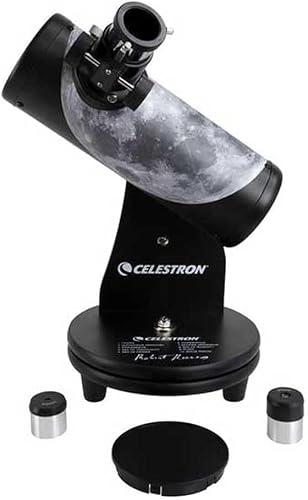
- 76mm aperture
- Tabletop Dobsonian mount
- Custom Moon map wrap
- 20mm and 4mm eyepieces
This compact tabletop Dobsonian is centered on lunar observing, with a Moon map wrap and a downloadable lunar guide. It is easy to move and store.
Pros
- Moon-themed design and guide
- Compact 4.3 lb body
- Simple Dobsonian pointing
Cons
- No finderscope included
- Needs a steady tabletop or support
The FirstScope Signature Series Moon is a compact tabletop scope built around lunar observing. It has a 76mm aperture, a Dobsonian mount and a Moon-themed wrap that highlights lunar features.
It includes 20mm and 4mm eyepieces, plus a downloadable lunar landscape guide. The compact 4.3 lb body is easy to move and store, though you'll need a stable table or another firm surface for observing.
There is no finderscope included, so locating objects takes more practice than with a scope that has a red dot finder. The Moon is an easy target to learn on, but the simple mount and small format suit casual sessions better than extended standing use.
Pick this model if you want a simple, Moon-centered starter scope that stores easily. It can also show other bright objects, making it more flexible than its lunar design suggests.
Celticbird 80mm Refractor: Best for a portable accessory kit

- 80mm refractor
- 20mm and 9mm eyepieces
- Backpack and phone adapter
- Moon filter included
The 80mm refractor comes with a backpack, phone adapter and moon filter. It suits buyers who want those accessories in one portable kit.
Pros
- Moon filter included
- Backpack and phone adapter included
- 80mm aperture
Cons
- Tripod is adjustable but requires careful setup
- Accessory quality may vary
The Celticbird 80mm Refractor bundles several accessories for portable lunar viewing. It includes a moon filter, 20mm and 9mm eyepieces, a phone adapter and a backpack.
Its 80mm aperture is larger than the 70mm refractors here, and the adjustable tripod ranges from 17.7 to 52 in. The included moon filter transmits 13 percent of incoming light, which some observers may prefer for reducing lunar brightness.
The phone adapter can help you try afocal phone photos through the eyepiece, though holding a phone steady and aligned takes patience. Use the filter only for the Moon.
It is not a solar filter and must never be used to view the Sun.
Choose this kit if its bundle of portability accessories matches your plans. For more on lunar brightness and filter choices, read do you need a moon filter for your telescope?.
What should you compare before choosing a lunar telescope?
Aperture, mount stability and aiming method matter more than a high magnification number. Start by deciding whether you need a portable scope, a tabletop reflector or a full-height tripod model.
Aperture affects how much light the telescope gathers. The 130mm Heritage and 114mm LT 114AZ offer more aperture than the 70mm Travel Scope and AstroMaster, while the 90mm MEEZAA and 80mm refractors sit between those choices.
The mount should feel manageable for the way you observe. A tabletop Dobsonian needs a firm support, while tripod models let you stand or sit; phone-guided models add directions to help locate targets.
Look at the included eyepieces, too. A wider, lower-power view is usually easier for finding and centering the Moon, while a shorter eyepiece gives a closer view when conditions allow.
What is the best magnification for viewing the Moon?
There is no single best magnification for every night because air movement and mount steadiness affect sharpness. Begin with the lower-power eyepiece, focus, and increase power only while craters and edges remain clear.
The Moon is large enough to show at low power, and a broad view helps you see the whole disk. Higher magnification can make features appear larger, but it also narrows the view and makes vibration more noticeable.
Don't choose a telescope by the largest magnification number in a kit. A steady, focused image at moderate power is more useful than a dim or shaky close-up.
When is the Moon easiest to study?
The Moon is rewarding at every phase, but the first and last quarter often show crater relief well. Shadows along the boundary between lunar day and night make ridges and crater walls easier to notice.
Near full Moon, sunlight falls more directly on the visible surface, so some terrain looks flatter. Full Moon remains bright and striking, and it's a convenient time to learn how to aim and focus.
Let the telescope adjust to outdoor conditions before expecting the sharpest view. Keep the mount steady, focus slowly and give your eyes time to adapt to the dark.
Do you need a moon filter for a telescope?
A moon filter is optional; it can reduce brightness for some observers, but it isn't required to see lunar detail. Start without one, then decide whether the view feels too bright for your eyes.
The Celticbird 80mm includes a filter designed for lunar use. Other telescopes in this roundup do not list one as an included accessory, so you can add one later if you want to experiment.
Moon filters are only for viewing the Moon. Never use a moon filter to look at the Sun.
How do you make a telescope session easier?
A stable setup and a low-power starting view make lunar observing easier. Put the tripod or tabletop base on firm ground, secure the accessories and begin with the wider eyepiece.
Align the finder in daylight on a distant object, then check it again on a bright night target. Our red dot finder setup guide covers alignment so you can center the Moon more quickly.
If the image seems soft, refocus and try again at lower power. For Newtonian models, check collimation if the image remains poor after careful focusing and a steady setup.
Which telescope for moon viewing should you choose?
Choose the LT 114AZ if you want the strongest mix of aperture and phone guidance, and the Heritage 130 if a tabletop scope with the largest aperture suits your space. Pick the Travel Scope 70 for trips, the LT 80AZ for guided family use, or the AstroMaster 70AZ for simple manual pointing.
For a compact lunar starter, the FirstScope Signature Series Moon is easy to store. Choose the MEEZAA 90mm or Celticbird 80mm when their included accessories fit your plans.
Before you buy, match the scope to your support surface, preferred aiming style and storage needs. Then follow our telescope setup guide for a smoother first night.
Our top 3 picks at a glance
-
1
Best for guided lunar sessions
Celestron StarSense Explorer LT 114AZ
8.8/10 our score
See it on Amazon -
2
Best for tabletop aperture
Sky-Watcher Heritage 130 Tabletop Dobsonian
8.5/10 our score
See it on Amazon -
3
Best for guided family viewing
Celestron StarSense Explorer LT 80AZ
8.4/10 our score
See it on Amazon
Frequently asked questions
What telescope is best for viewing the Moon?
A telescope with a steady mount and enough aperture to show lunar detail is a good starting point. The Celestron StarSense Explorer LT 114AZ combines a 114mm reflector with phone-guided aiming, while the Sky-Watcher Heritage 130 offers a larger 130mm aperture for tabletop use.
Choose based on where you can set up and how you want to find targets.
How much magnification do you need to see Moon craters?
You can see major lunar features at modest magnification, and more magnification does not always reveal more detail. Air movement, focus, optical quality and a steady mount all affect the view.
Start with the lower-power eyepiece, focus carefully, then try a higher-power eyepiece if the image stays sharp.
Is a moon filter necessary?
No, a moon filter is optional. Some observers prefer one to reduce the Moon's brightness, especially through a larger telescope, while others view without one.
A moon filter is only for lunar viewing and must never be used as a solar filter.
Can a small telescope show the Moon?
Yes. A small telescope can show the Moon's craters, mountain ranges and changing line between night and day.
The view depends on aperture, focus, conditions and how steady the mount is.
A 70mm refractor such as the Celestron Travel Scope 70 is a portable starting point.
What is the best time to observe the Moon?
The Moon is interesting at many phases. Near the first or last quarter, sunlight crosses the terminator, creating shadows that make craters and ridges easier to notice.
A full Moon is bright and striking, but the light falls more directly on much of its visible face, so surface relief can look flatter.