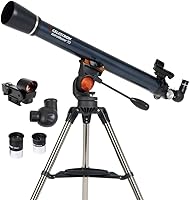
9 Best Easy-to-Use Telescopes for Beginners (November 2026)
The best easy-to-use beginner telescopes include the Celestron StarSense Explorer LT 114AZ for guided deep-sky exploring, the Sky-Watcher Heritage 150 Tabletop Dobsonian for a larger tabletop mirror, and the Celestron StarSense Explorer LT 80AZ for guided refractor viewing.
On this page (4 sections)
The Celestron StarSense Explorer LT 114AZ is our best telescope for beginners because it pairs a 114mm reflector with phone-guided target finding. Choose the Sky-Watcher Heritage 150 Tabletop Dobsonian for a larger mirror, or the Celestron StarSense Explorer LT 80AZ for guided refractor viewing.
A telescope's aperture matters, but so does your first session outside. Consider how you'll set up, point and focus the scope before choosing by mirror or lens size alone.
If you are still comparing telescope styles, read our telescope buying guide for adults and families. It covers aperture, mount types and the tradeoffs between refractors and reflectors.
Our picks at a glance
-
1
 Best for guided deep-sky exploring
Celestron StarSense Explorer LT 114AZ
8.8/10 our score
See it on Amazon -
2
 Best for a larger tabletop mirror
Sky-Watcher Heritage 150 Tabletop Dobsonian
8.6/10 our score
See it on Amazon -
3
 Best for guided refractor viewing
Celestron StarSense Explorer LT 80AZ
8.4/10 our score
See it on Amazon
Best telescope for beginners by viewing style
The Celestron StarSense Explorer LT 114AZ is the best all-around beginner pick here because its app helps locate targets and its 114mm mirror supports lunar, planetary and brighter deep-sky viewing. Other picks make sense when you prefer a tabletop base, a refractor or a travel-ready kit.
We compared each telescope's features against beginner needs: setup, target finding, portability, viewing flexibility and aperture. Our scores weigh those specs and features against what you're shopping for.
| Product | Best for | Aperture | Optical design | Mount | Our score |
|---|---|---|---|---|---|
| Celestron StarSense Explorer LT 114AZ | guided deep-sky exploring | 114mm | Newtonian reflector | Manual altazimuth with slow-motion altitude adjustment | 8.8 |
| Sky-Watcher Heritage 150 Tabletop Dobsonian | a larger tabletop mirror | 150mm | Reflector | Tabletop altazimuth Dobsonian | 8.6 |
| Celestron StarSense Explorer LT 80AZ | guided refractor viewing | 80mm | Refractor | Manual altazimuth with slow-motion altitude adjustment | 8.4 |
| Celestron AstroMaster 70AZ | simple family sessions | 70mm | Refractor | Manual altazimuth with panhandle | 7.9 |
| Celestron Travel Scope 80 | trips and storage | 80mm | Refractor | Tripod mount | 7.7 |
| Gskyer 70mm AZ Refractor | a compact accessory kit | 70mm | Refractor | Altazimuth | 7.4 |
| Celestron FirstScope Signature Series Moon | a simple Moon-first start | 76mm | Reflector | Manual tabletop Dobsonian | 7.3 |
| Dianfan 90mm Refractor | a longer focal length | 90mm | Refractor | Altazimuth | 7.3 |
| Celticbird 80mm Refractor | bundled travel accessories | 80mm | Refractor | Altazimuth | 7.1 |
Celestron StarSense Explorer LT 114AZ: Best for guided deep-sky exploring
- 114mm Newtonian reflector
- Phone-guided target finding
- Manual altazimuth mount
- 25mm and 10mm eyepieces
StarSense uses your phone to identify the telescope's position and guide you toward suggested targets. Its 114mm reflector is the largest aperture among the guided tripod models here.
Pros
- App-guided target finding
- 114mm aperture
- Includes 25mm and 10mm eyepieces
Cons
- Guidance requires a compatible smartphone
- Manual mount still needs you to move the telescope
The Celestron StarSense Explorer LT 114AZ pairs a 114mm Newtonian reflector with a phone dock and StarSense app. The app analyzes star patterns to find the telescope's position, then guides you toward targets chosen for your time and location.
That guidance helps with knowing where to aim. The mount remains manual, with an altitude slow-motion adjustment, so you move the telescope yourself and follow the app's arrows to line up a target.
It includes 25mm and 10mm eyepieces, a 2× Barlow lens, a tripod and a StarPointer finderscope. Celestron describes views of the Moon, planets and brighter deep-sky objects such as the Orion Nebula and Andromeda Galaxy.
Check that your phone meets the app's requirements before choosing this scope. StarSense Explorer supports Android 12 and later, plus iOS 18 and newer on iPhone XR and newer models.
Choose it if finding targets is your main concern and you want more aperture than the 80mm guided refractor. For your first observing session, follow our first-time telescope setup guide.
Sky-Watcher Heritage 150 Tabletop Dobsonian: Best for a larger tabletop mirror
- 150mm parabolic primary mirror
- Collapsible tube
- Tabletop Dobsonian base
- 750mm focal length
The 150mm mirror gathers more light than the smaller scopes in this roundup, and the collapsible tube aids storage. It needs a steady table or other firm surface for observing.
Pros
- Largest aperture in this roundup
- Collapsible tube for storage
- Tabletop base with rubber feet
Cons
- Needs a suitable table or platform
- Heavier than the small tabletop option
The Sky-Watcher Heritage 150 Tabletop Dobsonian is the largest-aperture telescope in this roundup, with a 150mm parabolic primary mirror and 750mm focal length. Its manual tabletop base lets you move the telescope up, down and side to side.
The collapsible tube reduces its size for storage and transport. The telescope still needs a sturdy, level surface, so plan for a table or platform before taking it outside.
It has a 1.25-inch helical focuser and rubber feet on the base to help reduce vibration. At 23 lb, it's heavier than the 4.3 lb Celestron FirstScope Signature Series Moon.
Pick it for a bigger mirror and a manual mount, provided you have a stable surface ready. For a side-by-side look at the optical styles, see our guide to Dobsonian vs refractor telescopes for beginners.
Celestron StarSense Explorer LT 80AZ: Best for guided refractor viewing
- 80mm refractor
- StarSense phone guidance
- Manual altazimuth mount
- Erect image diagonal
This refractor combines StarSense target guidance with a full-height tripod and an erect image diagonal. It's an option if you want help finding targets in a lens-based telescope.
Pros
- App-guided target finding
- Refractor design
- Includes an erect image diagonal
Cons
- Guidance requires a compatible smartphone
- Smaller aperture than the top two picks
The Celestron StarSense Explorer LT 80AZ gives beginners phone-guided target finding in a refractor package. Its 80mm aperture is smaller than the 114mm reflector above, and it includes an erect image diagonal and a full-height tripod.
Like the Celestron StarSense Explorer LT 114AZ, it uses the StarSense app to suggest objects and guide you toward them with on-screen arrows. The manual altazimuth mount has an altitude slow-motion adjustment, so the app helps with aiming while you make the movements.
The package includes 25mm and 10mm eyepieces, a 2× Barlow lens and a StarPointer red dot finderscope. The erect image diagonal gives you an upright view through the eyepiece.
Choose this model if you want app guidance in a refractor and a tripod setup. If you want to understand what aperture means for views, our 70mm telescope viewing guide offers a useful starting point.
Celestron AstroMaster 70AZ: Best for simple family sessions

- 70mm achromatic refractor
- Manual altazimuth panhandle
- Tool-free setup
- Day and night viewing
The AstroMaster's panhandle gives you direct control over pointing, and the refractor can also show daytime land targets. Its two eyepieces support lower- and higher-power views.
Pros
- Manual panhandle controls
- Suitable for daytime and night viewing
- No-tool setup
Cons
- 70mm aperture
- Manual pointing and tracking
The Celestron AstroMaster 70AZ keeps operation direct with a manual altazimuth mount and panhandle. It has tool-free assembly, a full-height adjustable tripod and support for both night-sky and daytime land viewing.
Its 70mm refractor includes 20mm and 10mm eyepieces, an erect image diagonal and a StarPointer red dot finder. These features support a conventional first-scope routine: point with the finder, look through the eyepiece and adjust focus.
This is an option for families who want to move between the Moon and distant daytime objects. Beginners should expect to learn target finding with the red dot finder and follow objects by moving the mount.
Choose it for panhandle control and day-to-night use. If you are unsure how much magnification to use, read our guide to calculating telescope magnification.
Celestron Travel Scope 80: Best for trips and storage

- 80mm refractor
- Included backpack
- Full-height tripod
- Smartphone adapter
The Travel Scope 80 packs into its included backpack and sets up without tools. It suits beginners who want one scope for the Moon, night skies and daytime scenery.
Pros
- Backpack included
- 80mm aperture
- Smartphone adapter included
Cons
- Requires tripod setup
- Phone photography requires adapter alignment
The Celestron Travel Scope 80 combines an 80mm refractor and included backpack in a 4.5 lb kit. Its tube and full-height tripod set up without tools and fit in the bag for storage or trips.
Two eyepieces support wide and closer views, while the included smartphone adapter lets you attach a phone for photos through the eyepiece. The scope also comes with a 5x24 finderscope and an erect image diagonal for daytime scenery and night viewing.
Its weight and packing setup are reasons to consider it alongside the Celestron StarSense Explorer LT 80AZ. The backpack keeps the tube, tripod and accessories together, while Starry Night software helps you plan observing sessions.
Choose it if easy packing matters most. Our guide to portable telescopes for travel and small spaces covers other compact options.
Gskyer 70mm AZ Refractor: Best for a compact accessory kit
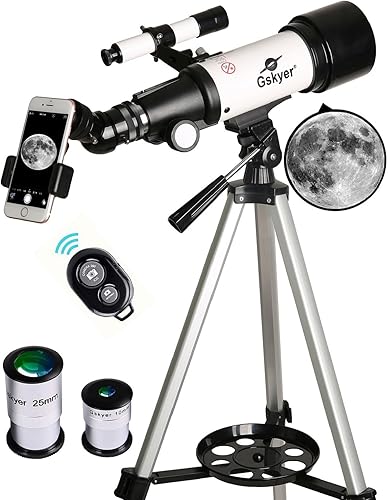
- 70mm refractor
- 400mm focal length
- Phone adapter and wireless remote
- Carry bag
This compact refractor includes a carry bag, phone adapter and wireless camera remote. Its 5x24 finder helps with manual target finding.
Pros
- Carry bag included
- Phone adapter and wireless remote
- 5x24 finder
Cons
- 70mm aperture
- Manual target finding
The Gskyer 70mm AZ Refractor bundles a carry bag, smartphone adapter and wireless camera remote with a compact refractor. Its 5x24 finder has crosshairs to help you locate a target before looking through the eyepiece.
The 2 eyepieces and 3× Barlow lens offer different magnification combinations. Start with the 25mm eyepiece to find and center an object, then try the 10mm eyepiece when the view is clear and steady.
This kit suits a beginner who wants phone accessories in the box. The wireless remote operates the phone's camera; you still point the telescope and follow objects yourself.
Choose it for a compact accessory bundle with a carry bag. Keep the first sessions simple by starting with the Moon and bright targets before moving to dimmer objects.
Celestron FirstScope Signature Series Moon: Best for a simple Moon-first start
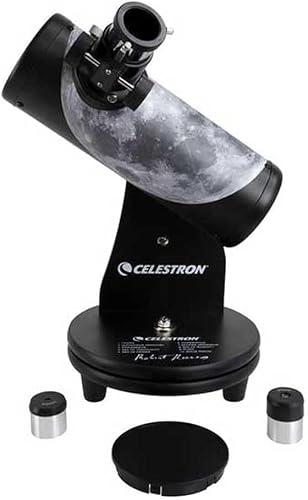
- 76mm tabletop reflector
- Dobsonian-style mount
- Moon map wrap
- Compact design
The FirstScope is designed for simple tabletop observing, with a Moon map wrap that highlights lunar features. Its compact format also suits a beginner who wants a small scope to store or carry.
Pros
- Simple tabletop Dobsonian mount
- Compact design
- Moon map wrap
Cons
- No finderscope included
- Needs a stable surface
The Celestron FirstScope Signature Series Moon offers a compact tabletop setup for a Moon-first beginner. It has a 76mm spherical mirror, a Dobsonian-style base and a custom wrap that marks lunar features.
The scope weighs 4.3 lb and needs a stable observing surface. It has no finderscope, so you point the tube by eye and move it across the sky with the base.
Its included 20mm and 4mm eyepieces give you 2 starting magnifications. Begin with the 20mm eyepiece to locate the Moon, then try the 4mm eyepiece if the view remains clear and steady.
Choose it if you want a compact scope for lunar observing. To learn about reducing lunar brightness at the eyepiece, read what a Moon filter does and when to use one.
Dianfan 90mm Refractor: Best for a longer focal length

- 90mm refractor
- 800mm focal length
- Two eyepieces and 3× Barlow lens
- Phone adapter and carry bag
The 90mm refractor has an 800mm focal length and comes with two eyepieces and a 3× Barlow lens. Its phone adapter and carry bag add options for sharing and storage.
Pros
- 90mm aperture
- 800mm focal length
- Carry bag included
Cons
- Allow about 15 minutes for assembly
- Manual target finding
The Dianfan 90mm Refractor offers a 90mm objective and 800mm focal length, along with 2 eyepieces and a 3× Barlow lens. Its 45-degree diagonal gives an upright, correctly oriented image for terrestrial viewing.
The included phone adapter and carry bag add options for photos and storage between sessions. Dianfan says assembly takes about 15 minutes, so allow time to put the tripod and telescope together before observing.
It has the largest aperture among the refractors in this roundup and includes a stainless steel tripod. The altazimuth mount requires you to find and follow targets yourself.
Choose it if you want a 90mm refractor and an upright terrestrial view. A stable, level setup helps keep the view steady while you learn to focus.
Celticbird 80mm Refractor: Best for bundled travel accessories

- 80mm refractor
- Backpack and phone adapter
- Adjustable tripod
- Two eyepieces and Moon filter
The Celticbird bundles a backpack, adjustable tripod, phone adapter and Moon filter with its 80mm refractor. Its two eyepieces offer different magnifications for lunar and planetary viewing.
Pros
- Backpack and phone adapter included
- Adjustable tripod
- Two eyepieces included
Cons
- Manual target finding
- Phone photography requires adapter alignment
The Celticbird 80mm Refractor includes a backpack, phone adapter, adjustable tripod and Moon filter. Its 20mm and 9mm eyepieces give you lower- and higher-power viewing options.
The bag helps keep the accessories together between sessions, while the tripod adjusts from 17.7 to 52 inches for different viewing heights. The phone adapter lets you position a phone camera at the eyepiece for photos.
The Moon filter reduces incoming light for lunar observing. It is not a solar filter, so never point the telescope or finder at or near the Sun.
Choose it if you want an 80mm refractor with travel accessories. For Moon viewing, start with the 20mm eyepiece and adjust focus before trying the 9mm eyepiece.
What makes a beginner telescope easy to use?
A beginner telescope is easier to use when its mount, finder and setup fit your observing routine. A large aperture can show more, but you also need to point the scope and place it somewhere steady.
Does phone guidance make a telescope easier for beginners?
Phone guidance can help if you don't know where to aim. StarSense Explorer models use a phone dock and app to identify the telescope's position and guide you toward suggested targets.
The mount remains manual on both StarSense Explorer scopes here. You'll still move the telescope and keep the object in view as Earth turns.
Is a tabletop telescope a good first scope?
A tabletop telescope can be a good first scope when you have a sturdy, level surface. The Sky-Watcher Heritage 150 Tabletop Dobsonian offers a larger mirror, while the Celestron FirstScope Signature Series Moon offers a smaller, lighter setup.
Measure the spot where you plan to observe and store the telescope. A table that wobbles can make focusing and tracking harder, even when the mount itself is simple.
Should you choose a refractor or a reflector?
Choose a refractor here if daytime viewing is a priority, or consider a reflector if you want the roundup's largest apertures. Compare the exact model's mount, target-finding tools and included accessories before deciding.
Our guide to refractors and Dobsonian telescopes explains the tradeoffs in more detail. For a reflector, also learn about collimating a Newtonian telescope before you need to adjust its mirrors.
What should you observe first?
Start with the Moon because it is bright and easy to recognize. After that, try bright planets when they are visible, then move to star clusters or brighter deep-sky objects from a darker location.
Use a low-power eyepiece first, since its wider view makes it easier to find and center a target. Our guide to telescope eyepieces explains how eyepiece choices change the view.
How do you choose the best telescope for beginners?
Choose the best telescope for beginners by deciding whether you need help finding targets, a larger mirror or a portable kit. Match the scope to your observing space and the parts of setup you want to keep simple.
Choose the Celestron StarSense Explorer LT 114AZ if target finding and aperture are your priorities. Pick the Sky-Watcher Heritage 150 Tabletop Dobsonian for a 150mm mirror, or the Celestron StarSense Explorer LT 80AZ for app guidance with a refractor.
For family use, the Celestron AstroMaster 70AZ has a panhandle and supports daytime viewing. Consider the Celestron Travel Scope 80 or Gskyer 70mm AZ Refractor if a bag and phone accessories are priorities.
Before your first clear night, assemble the scope in daylight and practice focusing on a distant land target well away from the Sun. Then use our first-time telescope setup guide to prepare for observing after dark.
Never aim a telescope or its finder at or near the Sun. Begin your night session with the Moon and a low-power eyepiece.
Which beginner telescope should you pick?
Pick the Celestron StarSense Explorer LT 114AZ if you want guided target finding with the largest aperture among the guided tripod choices. Choose the Sky-Watcher Heritage 150 Tabletop Dobsonian if you have a steady table and want a larger reflector.
For a beginner telescope you can pack in a backpack, consider the Celestron Travel Scope 80. If you prefer panhandle controls and daytime viewing, choose the Celestron AstroMaster 70AZ.
Once you've chosen, use our first-time telescope setup guide to prepare the mount, finder and eyepieces. Begin with the Moon before trying smaller or dimmer targets.
Our top 3 picks at a glance
-
1
Best for guided deep-sky exploring
Celestron StarSense Explorer LT 114AZ
8.8/10 our score
See it on Amazon -
2
Best for a larger tabletop mirror
Sky-Watcher Heritage 150 Tabletop Dobsonian
8.6/10 our score
See it on Amazon -
3
Best for guided refractor viewing
Celestron StarSense Explorer LT 80AZ
8.4/10 our score
See it on Amazon
Frequently asked questions
What is the easiest telescope for a beginner to use?
The Celestron StarSense Explorer LT 114AZ is our easiest all-around choice because its phone guidance helps you find targets. You still move the mount yourself.
A tabletop Dobsonian is another simple option if you have a steady surface and prefer to learn where to point without app guidance.
Is a refractor or reflector easier for a beginner?
Neither design is always easier; the mount and target-finding tools matter too. The Celestron StarSense Explorer LT 80AZ combines a refractor with phone guidance, while the Sky-Watcher Heritage 150 Tabletop Dobsonian offers a larger mirror on a manual tabletop base.
Compare setup, storage and pointing before choosing.
What can a beginner see with a telescope?
A beginner can start with the Moon, then try bright planets and star clusters when they are visible. Larger apertures and darker skies can help with faint objects, but city lights and atmospheric conditions affect the view.
Our guide to what a 70mm telescope can show explains realistic targets.
Do beginners need a computerized telescope?
No, beginners can start with a manual telescope, especially for the Moon and bright objects. Phone-guided models such as the Celestron StarSense Explorer LT 114AZ add target-finding help while keeping the mount manual.
Choose guidance if finding objects is your main concern, and expect to move the telescope yourself.
How should I choose my first telescope?
Choose by what you want to observe, where you'll set up and how you want to find targets. Aperture affects light gathering, while the mount and finder affect how easily you point and follow objects.
Our telescope buying guide for adults and families walks through those choices.