Equatorial vs Alt-Azimuth Telescope Mounts: Which Is Better? (November 2026)
Choose an alt-azimuth mount for direct up-down and left-right pointing, or an equatorial mount if you want to track targets with one main adjustment after polar alignment. This equatorial vs altazimuth mount guide helps you weigh setup, tracking and your observing habits.
On this page (7 sections)
- Equatorial vs altazimuth mount: which is easier to use?
- Which mount is better for a first telescope?
- How much setup does each telescope mount need?
- Does an equatorial mount track better at high magnification?
- What mistakes make a mount harder to use?
- Can you use an equatorial mount for casual stargazing?
- Which telescope mount should you choose?
Choose an alt-azimuth mount for direct up-down and left-right pointing, or an equatorial mount if you want to track targets with one main adjustment after polar alignment. In an equatorial vs altazimuth mount comparison, setup time and how long you watch each target are the key tradeoffs.
An alt-azimuth mount moves vertically and horizontally. An equatorial mount is aligned with Earth's rotation, so you can keep a target in view by turning its right ascension axis.
For a broader look at telescope styles and tradeoffs, start with our telescope buying guide. If you're new to assembly, see how to set up a telescope before your first night outside.

 Best for tabletop observing
Sky-Watcher Heritage 130 Tabletop Dobsonian
Equatorial vs altazimuth mount: which is easier to use?
An alt-azimuth mount is easier to point at first; an equatorial mount takes more setup but can simplify tracking. That difference matters most when you move between targets or watch one object for a long time.
With alt-azimuth movement, you aim up or down in altitude and left or right in azimuth. Those directions are easy to picture, whether you're aiming at the Moon or a star near the horizon.
An equatorial mount moves on right ascension and declination axes. Before using it to track, align its polar axis toward the celestial pole, which is near Polaris in the Northern Hemisphere.
The extra step has a purpose: once the mount is aligned, its tracking direction matches the apparent motion of the sky. But if you mostly look briefly at several targets, learning that alignment may not repay the effort.
How does an equatorial mount follow the sky?
After polar alignment, an equatorial mount can keep a target centered by turning the right ascension axis. Earth's rotation makes objects appear to drift, and this mount is designed to compensate for that motion.
First orient the mount's polar axis toward the celestial pole. Then aim the telescope and use the right ascension and declination controls to make fine corrections.
The telescope may move in a direction that feels unexpected compared with the target's motion in the eyepiece. Learn the controls in daylight, then use a bright target at night before trying to follow a faint one.
An equatorial mount can still be pointed without precise alignment. In that case, use it like a manually aimed telescope, but expect less benefit from its tracking geometry.
What does alt-azimuth tracking feel like?
A manual alt-azimuth mount follows a target through small adjustments on both axes. Pointing is direct, though you may need to nudge the telescope more often as an object crosses the sky.
If the target drifts out of view, move slightly up, down, left or right to bring it back. A slow-motion control can make these corrections finer on the axis it controls.
This movement suits quick looks and sessions where you change targets often. For extended viewing at high power, consider how comfortable you'll be making repeated corrections and whether a mount includes useful slow-motion controls.
Which mount is better for a first telescope?
Choose alt-azimuth for a shorter learning curve, or equatorial if learning to track is part of your goal. The best first mount is one you'll be comfortable setting up and using regularly.
A tabletop Dobsonian keeps the movement simple and avoids a separate tripod setup. The Sky-Watcher Heritage 130 Tabletop Dobsonian arrives assembled and needs a firm, steady table or other support at a comfortable height.
The Celestron StarSense Explorer LT 114AZ adds smartphone guidance to manual alt-azimuth pointing. Its app uses sky recognition to guide you toward suggested targets, while an altitude slow-motion adjustment helps with vertical movement.
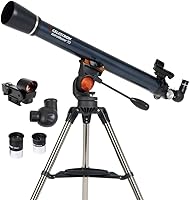
The Celestron AstroMaster 130EQ is the equatorial option here. Its right ascension and declination slow-motion knobs support fine adjustments, but you'll need to learn the mount's alignment and movement.
Our beginner telescope picks cover different setups, so you can compare the mount with the whole telescope. Skip an equatorial mount for now if extra alignment steps are likely to keep you from observing; skip a tabletop Dobsonian if you don't have a suitable support surface.
How much setup does each telescope mount need?
Alt-azimuth mounts usually need less alignment; equatorial mounts need polar alignment for useful tracking. Both need a stable base and a clear view of the sky.
For an alt-azimuth telescope, secure the tripod or base, level it if the instructions call for it, and aim at your target. A tabletop Dobsonian needs a firm surface that won't wobble when you touch the telescope.
An equatorial setup adds orientation before observing. Point the polar axis toward the celestial pole, then balance and aim the telescope as the manual directs.
The exact process varies by model, so use its instructions rather than assuming all mounts adjust the same way. Practice indoors in daylight: find the controls, learn which axis moves where, and rehearse pointing without needing to see small knobs in the dark.
Set the telescope somewhere with an unobstructed view and enough room to move around the tripod or base. Avoid leaning on the telescope while viewing, since a bump can shift the target and force you to begin aiming again.
If daytime scenery is also a priority, see our telescope vs spotting scope comparison. A spotting scope's upright image and compact tripod setup may matter more for that use than astronomical tracking.
Does an equatorial mount track better at high magnification?
An equatorial mount can make manual tracking easier at high magnification after alignment, but it doesn't guarantee steadier views. Mount stability, focusing, the atmosphere and the telescope all affect what you see.
At higher magnification, a target crosses the field of view more quickly. An alt-azimuth mount needs corrections on both axes; an equatorial mount lets you follow the sky's motion mainly with the right ascension control.
Slow-motion knobs can make small corrections easier to control. The AstroMaster 130EQ includes controls for both axes, while the StarSense Explorer LT 114AZ has altitude slow-motion adjustment.
Magnification isn't the same as detail. Choose an eyepiece that gives a view you can keep focused and centered.
Remember that a mount's tracking style won't improve a hazy or unsteady view. Our guide to calculating telescope magnification explains how eyepiece choice changes magnification.
What mistakes make a mount harder to use?
The most common mistake is choosing a mount for its tracking promise without considering setup and practice. A mount that fits your patience and observing routine is easier to use consistently.
One mistake is expecting an equatorial mount to work like a simple left-right, up-down base. Its axes follow the sky's coordinate system, so their movement can feel counterintuitive until you learn the controls.
Another is treating polar alignment as optional when tracking is the main reason you chose the mount. You can still point without precise alignment, but the mount won't track as effectively.
With alt-azimuth mounts, a common frustration is waiting too long to recenter a target. Make small corrections as it drifts, especially at higher magnification, instead of trying to make one large move after it leaves the field.
Forgetting the support surface is another avoidable problem. A tabletop Dobsonian needs a stable platform; a tripod needs firm footing and enough space to adjust without knocking a leg.
Finally, avoid changing several things at once when the view looks wrong. Check that the telescope is aimed at the intended target, refocus, and make a small mount adjustment before changing eyepieces or increasing magnification.
Can you use an equatorial mount for casual stargazing?
Yes, an equatorial mount works for casual viewing, but its tracking advantage matters less if you only glance at each target. If you prefer quick setup and frequent changes, an alt-azimuth mount may feel simpler.
You can point an equatorial telescope without precise alignment. Careful alignment matters when you want to keep one target centered over time, such as during a long look at a planet.
For a family session, simple movement can help each person take a turn without learning mount coordinates. For an observing session focused on one target, equatorial tracking can reduce the need to adjust both axes.
A useful compromise is to choose based on your most common night, not an occasional ambitious session. If you expect to set up often for short views, prioritize quick, intuitive pointing; if you want to practice alignment and tracking, accept the learning curve.
Which telescope mount should you choose?
Pick alt-azimuth for direct pointing and quick observing; pick equatorial if you value tracking and are willing to align the mount. This equatorial vs altazimuth mount decision comes down to the time you'll spend setting up versus keeping a target centered.
Choose a manual alt-azimuth mount if you want to move naturally between objects. Choose a guided model if finding targets is your main hurdle, or a tabletop Dobsonian if you have a stable surface ready.
Choose an equatorial mount if learning polar alignment is part of the appeal and you want to follow a target mainly with one tracking axis. The AstroMaster 130EQ is the fit among these options for that goal.
If alignment sounds like a chore, don't choose equatorial solely because it can track. If repeated nudging sounds frustrating, don't assume every manual alt-azimuth mount will feel effortless during a long high-power view.
For a first telescope, decide where you'll observe and how much setup you'll tolerate, then compare complete telescopes alongside their mounts. A simple mount you'll use often is a better fit than a tracking style that keeps you from getting started.
Frequently asked questions
Is an equatorial mount harder to use than an alt-azimuth mount?
An equatorial mount usually takes more setup because you need to align its polar axis with the sky's rotation axis. An alt-azimuth mount moves up-down and left-right, so its pointing directions are easier to understand at first.
After alignment, an equatorial mount can keep a target centered with one main axis adjustment.
Which telescope mount is better for beginners?
An alt-azimuth mount is often easier for a first telescope because its movements match how you point at objects: up, down, left and right. An equatorial mount can suit a beginner who wants to learn polar alignment and track targets with fewer direction changes.
Choose based on whether quick pointing or tracking practice sounds more useful.
Can you use an equatorial mount without polar alignment?
You can point a telescope on an equatorial mount without precise polar alignment, but tracking will be less useful. Polar alignment puts the mount's right ascension axis in line with Earth's rotation axis.
For casual viewing, rough alignment may be enough.
Longer tracking calls for more accurate alignment.
Does an alt-azimuth mount track stars?
A manual alt-azimuth mount can follow a star, but you adjust both altitude and azimuth as it moves across the sky. This may mean frequent small corrections at high magnification.
Some powered alt-azimuth systems can track automatically, depending on the mount and its controls.
Is a Dobsonian mount equatorial or alt-azimuth?
A standard Dobsonian mount is alt-azimuth. It moves the telescope up and down and side to side on a simple base.
That layout makes pointing direct, though you move both axes by hand to keep a target centered as Earth turns.