8 Best Telescopes for the Money (November 2026)
The best telescopes that offer strong value include the Celestron StarSense Explorer LT 114AZ for guided first sessions, the Sky-Watcher Heritage 150 Tabletop Dobsonian for more aperture in a compact base, and the Koolpte 80mm Refractor for a ready-to-carry starter kit.
On this page (12 sections)
- How we chose the best telescope for the money
- Compare these value telescopes by aperture and mount
- 1. Celestron StarSense Explorer LT 114AZ: Best for guided first sessions
- 2. Sky-Watcher Heritage 150 Tabletop Dobsonian: Best for more aperture in a compact base
- 3. Koolpte 80mm Refractor: Best for a ready-to-carry starter kit
- 4. MEEZAA 90mm Refractor: Best for a longer focal-length refractor
- 5. Celestron AstroMaster 130EQ: Best for learning an equatorial mount
- 6. Gskyer 70mm AZ Refractor: Best for a light travel kit
- 7. Celestron PowerSeeker 127EQ: Best for a value equatorial setup
- 8. Hawkko 90mm Refractor: Best for a complete refractor accessory set
- How should you choose a telescope that fits your budget?
- Which telescope is the best value for you?
The best telescope for the money for many beginners is the Celestron StarSense Explorer LT 114AZ, because its 114mm reflector comes with phone-guided help for locating targets. If you value aperture above guidance, consider the Sky-Watcher Heritage 150; for a lens-based design and bundled accessories, compare the Koolpte and MEEZAA refractors.
Value is about fit, not just the biggest number on a box. A telescope that is hard to carry, steady or point may stay indoors, so compare its mount and setup along with its aperture.
For a broader explanation of telescope types and mounts, start with our telescope buying guide. If this is your first scope, our guide to easy-to-use telescopes for beginners can help you decide how much setup you want to handle.
Our picks at a glance
-
1
 Best for guided first sessions
Celestron StarSense Explorer LT 114AZ
8.8/10 our score
See it on Amazon -
2
 Best for more aperture in a compact base
Sky-Watcher Heritage 150 Tabletop Dobsonian
8.6/10 our score
See it on Amazon -
3

How we chose the best telescope for the money
The best telescope for the money balances useful optics, a workable mount and features that solve a real beginner problem. We compared the stated aperture, optical design, mount style and included accessories against the needs of someone choosing a first or next telescope.
Our score weighs specs, features and buyer feedback against what you’re shopping for.
Aperture matters because it sets the opening that gathers light. But a larger aperture alone does not make a better match if the mount, storage needs or setup style do not suit your observing spot.
Mount type also changes the experience. Manual altazimuth mounts move up, down and side to side, while equatorial mounts need a little more learning before tracking feels natural.
A tabletop Dobsonian can keep the base compact, but it needs a stable support.
Compare these value telescopes by aperture and mount
The main differences are aperture, design and how each telescope is supported. Use the table to narrow the field, then read the matching notes before choosing a setup.
| Product | Best for | Aperture | Design | Mount | Our score |
|---|---|---|---|---|---|
| Celestron StarSense Explorer LT 114AZ | guided first sessions | 114mm | Newtonian reflector | Manual altazimuth | 8.8 |
| Sky-Watcher Heritage 150 Tabletop Dobsonian | more aperture in a compact base | 150mm | Tabletop Dobsonian reflector | Manual altazimuth | 8.6 |
| Koolpte 80mm Refractor | a ready-to-carry starter kit | 80mm | Refractor | Manual altazimuth | 7.8 |
| MEEZAA 90mm Refractor | a longer focal-length refractor | 90mm | Refractor | Manual altazimuth | 7.7 |
| Celestron AstroMaster 130EQ | learning an equatorial mount | 130mm | Newtonian reflector | Manual German equatorial | 7.5 |
| Gskyer 70mm AZ Refractor | a light travel kit | 70mm | Refractor | Manual altazimuth | 7.4 |
| Celestron PowerSeeker 127EQ | a value equatorial setup | 127mm | Newtonian reflector | Manual German equatorial | 7.0 |
| Hawkko 90mm Refractor | a complete refractor accessory set | 90mm | Refractor | Manual altazimuth | 6.9 |
Which telescope gives the best overall value?
The StarSense Explorer LT 114AZ is the most balanced pick here for a new observer who wants help finding objects. Its 114mm reflector, smartphone sky tour and manual altazimuth mount address three common beginner needs: aperture, target selection and simple directional movement.
Its phone feature is not required for viewing, but the sky recognition guidance can reduce the work of learning where objects are. You still move the telescope by hand and focus through the eyepiece.
When is more aperture worth choosing?
The Heritage 150 is the aperture choice, with a 150mm parabolic mirror and collapsible tube. It can be compelling if you have a stable table or platform and want a reflector that stores compactly.
A tabletop scope depends on the surface beneath it. Make sure you can place the base at a comfortable height with enough clearance to move and view safely.
1. Celestron StarSense Explorer LT 114AZ: Best for guided first sessions
Celestron StarSense Explorer LT 114AZ: Best for guided first sessions
- 114mm Newtonian reflector
- Phone-guided sky tours
- Manual altazimuth mount
- 25mm and 10mm eyepieces
Phone-guided target finding and a 114mm reflector make this a strong fit for beginners who want help choosing and locating objects. It includes two eyepieces and a full-height tripod.
Pros
- StarSense sky recognition app
- 114mm aperture
- Two eyepieces included
Cons
- Requires a compatible smartphone
- Manual mount needs hand adjustments
The Celestron StarSense Explorer LT 114AZ is the best fit for a beginner who wants help deciding where to point first. Its 114mm Newtonian reflector is paired with a smartphone dock and StarSense app, which uses sky recognition to guide you toward selected objects.
The app generates targets based on your time and location, then shows arrows to help you aim. The telescope remains manual: you move it by hand, and the mount includes an altitude slow-motion adjustment rod.
The included 25mm and 10mm eyepieces give you two starting views. The 2x Barlow lens, StarPointer finderscope and full-height tripod round out the setup.
This pick suits someone who might otherwise feel unsure about finding objects. Check phone compatibility before buying, since the stated requirements include Android 12 or later and iOS 18 or newer.
For an easier first-night routine, follow our first telescope setup guide.
2. Sky-Watcher Heritage 150 Tabletop Dobsonian: Best for more aperture in a compact base
Sky-Watcher Heritage 150 Tabletop Dobsonian: Best for more aperture in a compact base
- 150mm parabolic primary mirror
- Collapsible tube
- Tabletop altazimuth base
- 750mm focal length
A 150mm mirror and collapsible tube suit buyers who want more aperture without a full-height tripod. Its tabletop base needs a firm, level surface at a comfortable viewing height.
Pros
- Largest aperture in this roundup
- Collapsible tube aids storage
- Tabletop base has vibration-reducing feet
Cons
- Needs a sturdy table or similar support
- Manual pointing requires practice
The Sky-Watcher Heritage 150 is the strongest aperture pick, with a 150mm parabolic primary mirror and a 750mm focal length. Its collapsible tube can help with storage and portability, while the tabletop Dobsonian base keeps the mount simple and manual.
The tradeoff is the support surface. This telescope does not use a full-height tripod, so plan for a sturdy table, bench or other level support that puts the eyepiece at a comfortable height.
Rubber feet are designed to reduce vibration, and the tube design is intended to retain collimation when collapsed. Reflector owners should understand what collimation is and when to check it.
Our guide to collimating a Newtonian telescope explains the basic process.
Choose the Heritage 150 if more aperture and compact storage matter more than having a tripod in the setup. It may be less convenient if you observe where no firm, level support is available.
3. Koolpte 80mm Refractor: Best for a ready-to-carry starter kit
Koolpte 80mm Refractor: Best for a ready-to-carry starter kit
- 80mm refractor
- 600mm focal length
- Phone adapter and carrying bag
- 25mm and 10mm eyepieces
This refractor includes a phone adapter, wireless remote and carrying bag with two eyepieces. It fits buyers who value an all-in-one kit and a lens-based telescope.
Pros
- 80mm objective lens
- Carrying bag included
- Phone adapter and wireless remote included
Cons
- Tripod and mount are manual
- Magnification claims do not guarantee useful detail
The Koolpte 80mm Refractor suits a beginner who wants a lens-based telescope with a carrying bag and phone accessories in the box. Its 80mm aperture and 600mm focal length offer a middle ground between the 70mm Gskyer and the larger reflectors in this list.
The kit includes 25mm and 10mm eyepieces, a 3x Barlow lens, a phone adapter and a wireless remote. Koolpte describes setup as requiring no tools, though you should still take time to level the tripod and learn the controls before observing.
The phone adapter can help center a phone camera over the eyepiece, but it does not turn the telescope into a dedicated astrophotography rig. Start with the Moon and bright targets, then adjust focus and phone position carefully.
Choose this scope if portability and bundled accessories matter more than a larger mirror. If you are deciding whether a phone adapter is useful, see our guide to telescope phone adapters.
4. MEEZAA 90mm Refractor: Best for a longer focal-length refractor
MEEZAA 90mm Refractor: Best for a longer focal-length refractor

- 90mm aperture
- 800mm focal length
- Phone adapter and carry bag
- 10mm and 25mm eyepieces
The 90mm objective and 800mm focal length make this a lens-based option for lunar and general sky viewing. It includes a tripod, carry bag, phone adapter and two eyepieces.
Pros
- 90mm aperture
- Two eyepieces and a 3x Barlow lens
- Carry bag included
Cons
- Adjustable tripod height does not guarantee stability
- High magnification is not a substitute for steady viewing
The MEEZAA 90mm Refractor is a sensible pick if you want a refractor with more aperture than the 70mm travel option. Its 800mm focal length, 90mm objective lens and included 25mm and 10mm eyepieces make it an option for lunar and general observing.
The kit also includes a 3x Barlow lens, phone adapter, carry bag, finder scope and adjustable stainless steel tripod. The included parts offer flexibility, while the view depends on focus, sky conditions and keeping the telescope steady.
MEEZAA says most users assemble it in about 10 minutes. Allow extra time if you are unfamiliar with telescope parts or need to align the finder.
Choose the MEEZAA when you prefer a 90mm refractor and want a carry bag with phone accessories. The Hawkko also offers a 90mm aperture, so compare the focal lengths and included kits rather than choosing by magnification claims.
5. Celestron AstroMaster 130EQ: Best for learning an equatorial mount
Celestron AstroMaster 130EQ: Best for learning an equatorial mount
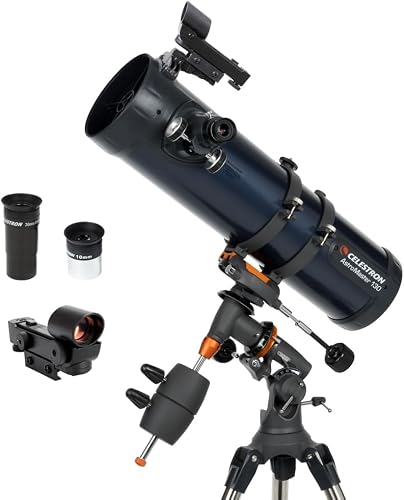
- 130mm Newtonian reflector
- German equatorial mount
- Slow-motion controls
- 20mm and 10mm eyepieces
A 130mm mirror provides useful aperture, while the German equatorial mount introduces a different way to track the sky. Choose it if you are willing to learn polar alignment and mount movement.
Pros
- 130mm aperture
- Slow-motion controls on both axes
- Two eyepieces included
Cons
- Equatorial mount has a steeper learning curve
- Heavier than the small refractor options
The Celestron AstroMaster 130EQ combines a 130mm Newtonian reflector with a German equatorial mount. It suits a buyer who wants a reflector and is willing to learn how an equatorial setup points and tracks.
Its mount uses slow-motion controls for right ascension and declination. That setup can feel less direct than moving a telescope up, down and side to side, so expect a learning period before aiming feels intuitive.
The package includes a 20mm eyepiece with a built-in erect image corrector, a 10mm eyepiece and a StarPointer red dot finderscope. Celestron also includes a software download for planning sessions.
If you are comparing mount styles, read our equatorial versus alt-azimuth mount guide. Choose the AstroMaster if you want to learn equatorial movement; choose an altazimuth model if direct up, down and side-to-side motion sounds better.
6. Gskyer 70mm AZ Refractor: Best for a light travel kit
Gskyer 70mm AZ Refractor: Best for a light travel kit
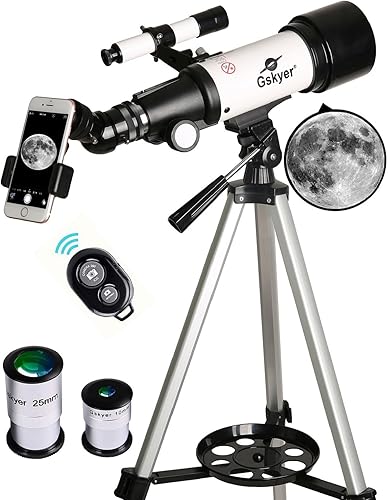
- 70mm refractor
- 400mm focal length
- Carrying bag
- Phone adapter and wireless remote
The 70mm refractor comes with a carrying bag, phone adapter and wireless remote, making it a portable starter option. Its smaller aperture makes it better suited to bright targets than faint deep-sky objects.
Pros
- 5.7 lb telescope weight
- Carrying bag included
- Phone adapter and remote included
Cons
- Smallest aperture in this roundup
- Short focal length limits its role for higher-power viewing
The Gskyer 70mm AZ Refractor is the portability pick, with a stated weight of 5.7 lb and a carrying bag for the telescope and tripod. Its 70mm aperture and 400mm focal length make it a compact choice for bright targets and casual sessions.
The kit includes two eyepieces, a 3x Barlow lens, a finder scope, phone adapter and wireless camera remote. Those extras support basic phone snapshots, but a phone adapter does not remove the limits of the aperture or manual mount.
The short focal length and manual altazimuth mount make it a compact setup to store and point. A smaller telescope may also suit a child or family member who wants to learn the sky.
Choose it for travel and convenience rather than faint deep-sky viewing. Our 70mm telescope guide gives a more detailed sense of the targets a scope this size can show.
7. Celestron PowerSeeker 127EQ: Best for a value equatorial setup
Celestron PowerSeeker 127EQ: Best for a value equatorial setup

- 127mm Newtonian reflector
- Manual German equatorial mount
- 20mm and 4mm eyepieces
- 3x Barlow lens
This 127mm reflector includes a German equatorial mount and several optical accessories. It may suit a buyer drawn to this mount style, but the short 4mm eyepiece and Barlow do not guarantee clear high-power views.
Pros
- 127mm aperture
- Slow-motion mount controls
- Two eyepieces and a Barlow lens
Cons
- Equatorial mount takes learning
- Included high-power combinations may be difficult to use
The Celestron PowerSeeker 127EQ offers a 127mm Newtonian reflector and a manual German equatorial mount. It can appeal to a buyer who wants this mount style and a substantial mirror.
The included 20mm and 4mm eyepieces, 3x Barlow lens and finderscope provide several ways to configure a view. Stacking high-magnification accessories does not guarantee a sharper image; atmospheric steadiness, focus and mount stability all matter.
This model asks you to learn equatorial movement and slow-motion controls. If you want a telescope that is quick to point for casual viewing, an altazimuth scope may be a simpler match.
Choose the PowerSeeker if you are committed to learning the mount and will take time to set it up carefully. Buyers who prefer a reflector with slightly larger aperture can compare the AstroMaster 130EQ above.
8. Hawkko 90mm Refractor: Best for a complete refractor accessory set
Hawkko 90mm Refractor: Best for a complete refractor accessory set
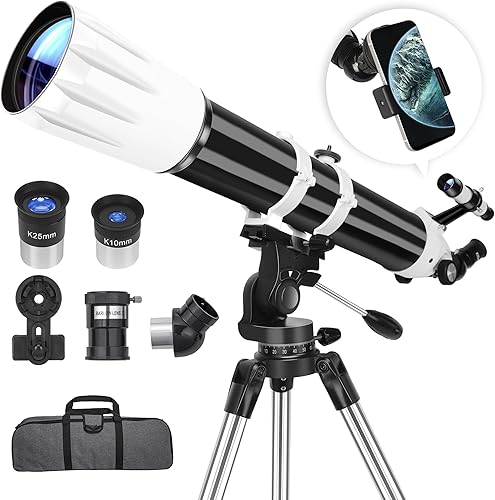
- 90mm aperture
- 900mm focal length
- Phone adapter and carry bag
- 25mm and 10mm eyepieces
The Hawkko pairs a 90mm objective with a phone adapter, carry bag and two eyepieces. It is an accessory-rich refractor option with a longer focal length than the MEEZAA 90mm.
Pros
- 90mm aperture
- Carry bag and phone adapter included
- 900mm focal length
Cons
- No clear differentiator from the MEEZAA 90mm on the available features
- Phone photography depends on alignment and conditions
The Hawkko 90mm Refractor combines a 90mm objective, 900mm focal length and manual altazimuth mount. It includes a carry bag, phone adapter, finder scope, accessory tray, 25mm and 10mm eyepieces, and a 3x Barlow lens.
That accessory set may suit someone who wants the basic pieces together. The stated 36x to 270x magnification range should not drive the decision on its own, because high power can make an image dimmer and harder to keep steady.
The main comparison is with the MEEZAA 90mm Refractor. The Hawkko has a longer focal length, while both scopes include a phone adapter, carry bag and 90mm objective.
Choose based on which focal length and included kit better match your priorities.
If the two options feel too close, decide whether you would rather have a larger reflector, phone-guided target finding or a smaller travel telescope.
How should you choose a telescope that fits your budget?
The right value telescope is the one whose design and mount match where and how you observe. Before buying, consider these practical points:
- Choose aperture for your targets. Larger mirrors gather more light, but a bigger telescope can take more room and support planning.
- Choose a mount you can operate. Altazimuth mounts point directly; equatorial mounts need extra setup and learning.
- Check the support surface. A tabletop Dobsonian needs a stable platform at a useful viewing height.
- Treat magnification claims carefully. The eyepiece, atmosphere, focus and mount all affect the view.
- Consider guidance and accessories. Phone guidance can help locate targets, while a carrying bag can make storage and transport simpler.
If you have a firm spending limit, compare our telescopes under 500 dollars picks. If portability is the main goal, our portable telescope roundup focuses on compact setups.
For a first observing plan, the NASA Night Sky Network offers astronomy outreach resources and observing activities. Start with easy bright targets, give your eyes time to adjust to darkness, and learn one mount control at a time.
Which telescope is the best value for you?
Choose the StarSense Explorer LT 114AZ if phone guidance and a 114mm reflector make learning the sky easier. Pick the Heritage 150 if you want the largest aperture here and have a stable support surface.
Choose the Gskyer 70mm for a light travel kit, or compare the Koolpte and MEEZAA if a refractor with bundled accessories fits your plans. For more help with the decision, start with our telescope buying guide.
Our top 3 picks at a glance
-
1
Best for guided first sessions
Celestron StarSense Explorer LT 114AZ
8.8/10 our score
See it on Amazon -
2
Best for more aperture in a compact base
Sky-Watcher Heritage 150 Tabletop Dobsonian
8.6/10 our score
See it on Amazon -
3
Frequently asked questions
What makes a telescope good value for the money?
A good-value telescope combines usable aperture, a mount you can manage and accessories that fit how you plan to observe. A larger aperture can show more, but only if the mount is steady enough and setup feels practical for you.
Compare the full setup and your likely targets, not just magnification claims.
Should I choose a reflector or a refractor?
A reflector uses mirrors and can offer larger aperture for its size, while a refractor uses a front lens and often comes as a ready-to-carry kit. Reflectors may need collimation checks, and a refractor's tripod still matters for stable viewing.
Choose by the setup you will use regularly.
Is a phone-guided telescope worth it?
Phone guidance can help you find targets when you are new to the sky. The StarSense Explorer LT 114AZ uses sky recognition to guide aiming, while its manual altazimuth mount still needs your hand to move and track the telescope.
It helps with finding objects, not automatic tracking.
How much aperture do I need for a first telescope?
Aperture affects how much light a telescope gathers, but there is no single size that fits every beginner. This roundup ranges from a 70mm refractor to a 150mm reflector, with tradeoffs in portability, mount style and setup.
Pick the largest setup you can store, carry and use comfortably.


