9 Best Refractor Telescopes for Beginners (November 2026)
The best refractor telescopes for beginners include the Celestron StarSense Explorer LT 80AZ for phone-guided stargazing, the MEEZAA 90mm Refractor for a larger aperture kit, and the Celestron AstroMaster 70AZ for simple manual pointing.
On this page (5 sections)
The Celestron StarSense Explorer LT 80AZ is the best refractor telescope for most beginners, with app guidance and an 80mm aperture for viewing the Moon, planets and brighter deep-sky targets. Choose a Celestron Travel Scope for a backpack kit or a 90mm model for a larger objective.
A refractor uses a lens at the front of the tube, so routine setup doesn’t involve adjusting a secondary mirror. For a first scope, compare aperture, mount controls, portability and how much help you want finding objects.
If you’re deciding between telescope types, our Dobsonian versus refractor guide explains the practical differences. For a wider overview of first-scope choices, see easy-to-use telescopes for beginners.
Our picks at a glance
-
1
 Best for phone-guided stargazing
Celestron StarSense Explorer LT 80AZ
8.4/10 our score
See it on Amazon -
2

-
3


Which refractor telescope is easiest for a beginner to use?
The Celestron StarSense Explorer LT 80AZ is the easiest pick here for finding targets because its smartphone app uses sky recognition and on-screen arrows. The other models rely on manual pointing with a finder or by sweeping the sky.
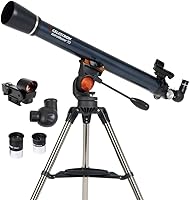
Celestron StarSense Explorer LT 80AZ: Best for phone-guided stargazing
- 80mm refractor
- StarSense sky recognition app
- Manual altazimuth mount
- 10mm and 25mm eyepieces
The StarSense app uses sky recognition and on-screen arrows to help you locate targets. Its 80mm refractor is suited to the Moon, planets and brighter deep-sky objects.
Pros
- App-guided target finding
- 80mm aperture
- Includes two eyepieces and a red dot finder
Cons
- Phone compatibility depends on operating system and model
- Manual mount requires you to point and track
The StarSense Explorer LT 80AZ is a clear fit if the hard part of stargazing is knowing where to point. Dock a compatible phone, open the app and follow the arrows; the bullseye turns green when the target is in view.
Its 80mm refractor is suited to the Moon, Jupiter, Saturn and brighter targets such as the Orion Nebula and Andromeda Galaxy. The manual altazimuth mount includes an altitude slow-motion adjustment for finer pointing control.
The kit includes 25mm and 10mm eyepieces, a 2x Barlow lens, an erect image diagonal and a StarPointer red dot finder. Check phone and operating system compatibility before choosing this model.
Pick it if app guidance would make your first sessions easier. If you prefer manual pointing, the AstroMaster 70AZ has a panhandle mount and red dot finder.
Which beginner refractor gives you the largest aperture?
The MEEZAA, Dianfan and Hawkko have 90mm apertures, the largest among these picks. The MEEZAA has an 800mm focal length and a 3x Barlow lens, while the Dianfan includes a 45-degree mirror for upright terrestrial views.
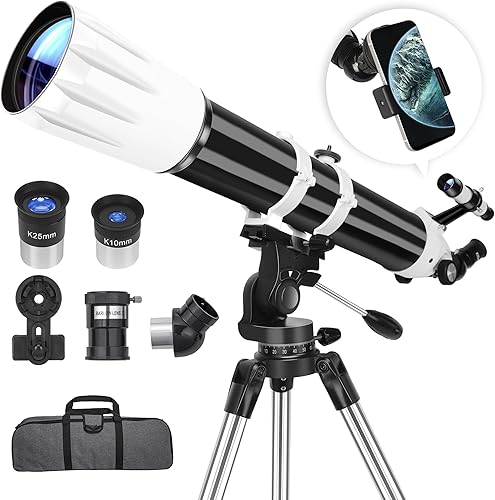
MEEZAA 90mm Refractor: Best for a larger aperture kit
- 90mm aperture
- 800mm focal length
- 10mm and 25mm eyepieces
- 3x Barlow lens and carry bag
The 90mm objective and 800mm focal length make this a larger refractor option. It includes two eyepieces, a Barlow lens, phone adapter and bag.
Pros
- Largest stated aperture in this roundup
- Includes a 3x Barlow lens
- Carry bag included
Cons
- Phone adapter does not guide the telescope to targets
- Assembly time may vary
The MEEZAA 90mm Refractor suits beginners who want a larger lens and starter accessories. Its 800mm focal length, 10mm and 25mm eyepieces, and 3x Barlow lens give you several ways to frame a target.
The kit includes a phone adapter, finder scope, accessory tray, stainless steel tripod and carry bag. The phone adapter holds a phone for photos; it doesn’t point the telescope toward objects.
The tube and tripod need room for setup and storage. High magnification can make it harder to get a sharp view, especially when the image is unsteady.
Choose it if aperture and accessories matter more than a backpack-style kit. For a 90mm scope with an upright image for daytime viewing, compare the Dianfan below.
Dianfan 90mm Refractor: Best for upright daytime views

- 90mm aperture
- 800mm focal length
- 45-degree zenith mirror
- Phone adapter and carry bag
The Dianfan includes a 45-degree zenith mirror for upright terrestrial viewing, along with a 90mm objective and an 800mm focal length. A phone adapter and bag are also included.
Pros
- 90mm aperture
- Upright image for terrestrial viewing
- Phone adapter and carry bag included
Cons
- Assembly may take about 15 minutes
- No phone-guided target system described
The Dianfan 90mm Refractor suits someone who wants one scope for astronomy and terrestrial viewing. Its 45-degree zenith mirror gives upright, correctly oriented images for daytime targets.
For night use, its 90mm objective and 800mm focal length put it in the same aperture class as the MEEZAA. It includes 10mm and 25mm eyepieces, a 3x Barlow lens, phone adapter, finder and carry bag.
Assembly takes about 15 minutes with the instructions. Set the tripod on flat ground and secure its fasteners before observing.
Pick the Dianfan when upright daytime views are useful. If portability is the priority, a backpack-style Travel Scope is easier to carry as a complete kit.
Which refractor is easiest to take on a trip?
The Celestron Travel Scope 70 and Travel Scope 80 both include backpacks and are designed for portability. The 70mm version weighs 4.2 lb, while the 80mm model weighs 4.5 lb and includes a phone adapter.
Celestron Travel Scope 70: Best for a compact starter kit

- 70mm refractor
- Backpack included
- No-tool setup
- 20mm and 10mm eyepieces
The Travel Scope 70 is a portable 70mm option with a backpack, two eyepieces and a no-tool setup. It can also be used for daytime scenery.
Pros
- Backpack included
- No-tool setup
- Useful for daytime and night viewing
Cons
- Smaller aperture than the 80mm and 90mm picks
- No phone adapter included
The Travel Scope 70 is a straightforward choice for campsite astronomy and daytime scenery. Its 70mm aperture, 20mm and 10mm eyepieces, and no-tool setup keep the kit simple.
The backpack stores the telescope and accessories together. A 5x24 finder and 45-degree erect image diagonal help with locating targets and viewing land objects in a natural orientation.
Its 70mm aperture is smaller than the 80mm and 90mm options here, so it suits bright targets. Choose it if low-fuss packing matters more than aperture.
Celestron Travel Scope 80: Best for portable 80mm viewing

- 80mm refractor
- Backpack included
- Smartphone adapter
- 20mm and 10mm eyepieces
The Travel Scope 80 pairs an 80mm refractor with a backpack for storage and transport. Its included smartphone adapter is for capturing images through the eyepiece.
Pros
- Backpack included
- No-tool setup
- Includes a smartphone adapter
Cons
- Phone adapter is for imaging, not target guidance
- Manual target finding is required
The Travel Scope 80 pairs an 80mm objective with a backpack, two eyepieces, a 5x24 finder and a smartphone adapter. The adapter is for taking images through the eyepiece, not app-guided sky navigation.
For finding objects, use the finder and point the telescope manually. Its no-tool setup makes it practical to take out when you have a clear observing window.
Consider the 70mm Travel Scope if you want the smaller aperture and don’t need the phone adapter.
What should you compare before buying a beginner refractor?
Compare aperture, target-finding help, mount controls and the gear you’ll carry to your observing spot. A larger aperture can collect more light, while a usable mount and finder can make it easier to locate objects.
| Product | Best for | Aperture | Mount | Included eyepieces | Our score |
|---|---|---|---|---|---|
| Celestron StarSense Explorer LT 80AZ | phone-guided stargazing | 80mm | Manual altazimuth with altitude slow motion adjustment | 10mm and 25mm | 8.4 |
| MEEZAA 90mm Refractor | a larger aperture kit | 90mm | Altazimuth | 7.7 | |
| Celestron AstroMaster 70AZ | simple manual pointing | 70mm | Manual altazimuth with panhandle | 7.9 | |
| Celestron Travel Scope 70 | a compact starter kit | 70mm | Altazimuth | 8.0 | |
| Koolpte 80mm Refractor | phone adapter accessories | 80mm | Altazimuth | 7.8 | |
| Celestron Travel Scope 80 | portable 80mm viewing | 80mm | Not specified in product data | 7.7 | |
| Dianfan 90mm Refractor | upright daytime views | 90mm | Altazimuth | 7.3 | |
| Celticbird 80mm Refractor | a family carry kit | 80mm | Altazimuth | 7.1 | |
| Hawkko 90mm Refractor | longer focal length | 90mm | Altazimuth | 6.9 |
Is 70mm or 80mm better for a first telescope?
An 80mm refractor gathers more light than a 70mm model, but it may take up more room in a travel kit. The better choice depends on whether you value aperture or easier packing more.
The Celestron Travel Scope 70 includes a backpack and no-tool setup. The Travel Scope 80 adds an 80mm objective and smartphone adapter, while the StarSense Explorer LT 80AZ adds app-based target guidance.
For help setting expectations, read what you can see with a 70mm telescope. Visible detail also depends on focus, sky conditions and mount steadiness.
Does a phone adapter help you find stars?
A phone adapter holds a phone for photography; it does not guide the telescope to a target. The StarSense Explorer LT 80AZ is different because its app uses sky recognition to guide pointing.
The Travel Scope 80, Koolpte, MEEZAA, Dianfan, Celticbird and Hawkko include phone adapters, but their features don’t describe app-based target guidance. If you want to photograph your views, read what to know about telescope phone adapters.
How much magnification do you need?
Start with low magnification, center the target, then increase power if the view remains steady. High magnification makes it harder to keep an object in view and can make atmospheric blur more noticeable.
Many of these kits include multiple eyepieces, and some include a Barlow lens. Our telescope eyepieces guide explains how eyepiece choices affect the view.
What makes a refractor beginner-friendly?
Simple setup, clear mount controls and a finder can make a first telescope easier to use. A phone-guided system can reduce guesswork, while a red dot or optical finder helps with manual pointing.
Place the tripod on level ground where you plan to observe. Our first-time telescope setup guide covers basic assembly and alignment.
How do you choose the best refractor telescope for beginners?
Choose the StarSense Explorer LT 80AZ for phone guidance, the Travel Scope 70 or 80 for a backpack kit, or a 90mm model for a larger objective. The best refractor telescope for you is the one whose setup and target-finding method you’ll use often.
The MEEZAA offers a 90mm aperture with a Barlow lens and carry bag. The Dianfan also has a 90mm objective, with an upright-image mirror for daytime viewing.
Before your first night, review how to set up a telescope and start with a low-power eyepiece. It can make finding and centering a target easier before you try a closer view.
Our top 3 picks at a glance
-
1
Best for phone-guided stargazing
Celestron StarSense Explorer LT 80AZ
8.4/10 our score
See it on Amazon -
2
-
3
Frequently asked questions
What is a refractor telescope good for?
A refractor uses lenses to gather and focus light. Beginner models are commonly used to view the Moon, planets and bright star clusters, while the clearest targets depend on aperture, sky conditions and setup.
Some models also include an erect image diagonal for daytime scenery.
Is an 80mm refractor good for beginners?
An 80mm refractor can be a useful first telescope if you want a manageable aperture for the Moon, planets and brighter objects. The Celestron StarSense Explorer LT 80AZ adds phone-based target guidance, while the Travel Scope 80 includes a backpack and phone adapter.
A phone adapter helps with imaging, not locating targets.
What can you see with a 70mm refractor?
A 70mm refractor can show lunar craters and the brighter planets, with views shaped by focus, atmospheric conditions and how steady the mount is. Bright star clusters can also be suitable targets.
See our guide to what you can see with a 70mm telescope for a closer look at realistic expectations.
Do refractor telescopes need collimation?
Most beginners do not need to adjust a refractor's optics as part of routine setup. Set the tripod on stable ground, attach the tube securely and focus on a distant daytime object before observing at night.
Our first telescope setup guide walks through the basic steps.
How much magnification should a beginner use?
Start with the lower-power eyepiece, which gives a wider view and makes it easier to find a target. Increase magnification only after the object is centered and the image looks steady.
Our telescope magnification guide explains how eyepiece focal length changes magnification.