8 Best Telescopes Under $100 (November 2026)
The best telescopes under 100 dollars include the Celestron Travel Scope 70 for travel families, the Koolpte 80mm Refractor for casual phone photos, and the Gskyer 70mm AZ Refractor for compact phone imaging.
On this page (6 sections)
The best telescope under 100 dollars for most beginners is the Celestron Travel Scope 70, a portable refractor with two eyepieces, a backpack and no-tool setup. Choose the FirstScope for a tabletop Moon scope, or the National Geographic reflector if aperture is your priority.
A beginner telescope should make it easy to find a target, focus and keep the view steady. The 8 picks here suit different needs, from a compact family scope to an 80mm refractor or a reflector with a larger stated aperture.
Start with the telescope buying guide for adults and families if you're unsure which design fits your space. Our beginner telescope picks cover more starter options, and the telescopes under 500 dollars guide helps if you can raise your budget.
Our picks at a glance
-
1

-
2

-
3
- 4
 Check it
Celestron FirstScope Signature Series Moon
Best for tabletop lunar viewing - 5
 Best for adjustable family setupCheck it
- 6
 Best for all-in-one travel kitsCheck it
- 7
 Best for marked aiming controlsCheck it
- 8
 Check it
National Geographic 114mm Reflector
Best for larger light-gathering aperture
How to choose the best telescope under 100 dollars
The best telescope under 100 dollars for you is the one you can set up steadily and use for the targets you care about. Compare aperture, optical design, mount, included eyepieces and carrying needs before considering extra accessories.
Aperture is the diameter of the telescope's main lens or mirror. A wider opening collects more light, which can help with dimmer targets, but aperture alone does not make a telescope easy to use.
Mount style affects how quickly you can point and steady the view. Alt-azimuth mounts move up and down and side to side, while a tabletop Dobsonian rests on a support and moves by hand.
Eyepieces change magnification, but higher power is not always better. A narrow, dim or shaky view can make a target harder to find, so start low and increase power only when the image stays clear.
| Product | Best for | Aperture | Design | Included | Our score |
|---|---|---|---|---|---|
| Celestron Travel Scope 70 | travel families | 70mm | Refractor | Backpack, tripod, two eyepieces | 8.0 |
| Koolpte 80mm Refractor | casual phone photos | 80mm | Refractor | Phone adapter, remote, carrying bag | 7.8 |
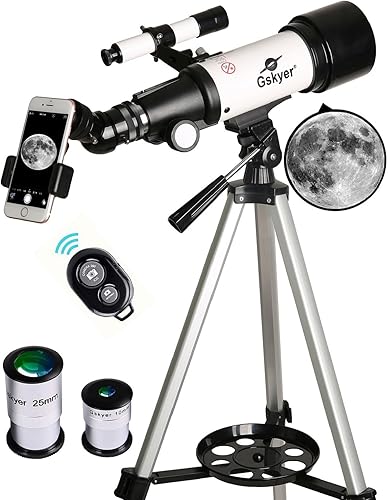
| Gskyer 70mm AZ Refractor | compact phone imaging | 70mm | Refractor | Phone adapter, remote, carry bag | 7.4 |
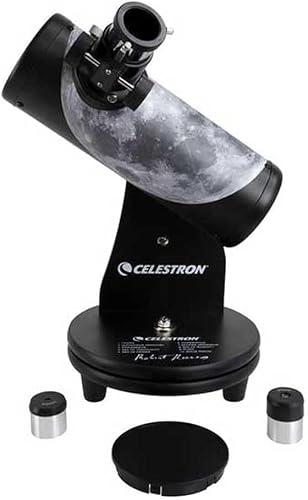
| Celestron FirstScope Signature Series Moon | tabletop lunar viewing | 76mm | Tabletop Dobsonian reflector | Two eyepieces, Moon map wrap | 7.3 |
| Celticbird 80mm Refractor | adjustable family setup | 80mm | Refractor | Backpack, phone adapter, Moon filter | 7.1 |
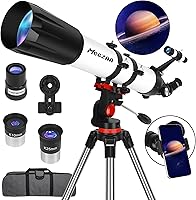
| MEEZAA 80mm Refractor | all-in-one travel kits | 80mm | Refractor | Backpack, phone adapter, finder scope | 6.9 |
| EACONN 80mm Refractor | marked aiming controls | 80mm | Refractor | Backpack, phone adapter, adjustable tripod | 6.7 |
| National Geographic 114mm Reflector | larger light-gathering aperture | 114mm | Newtonian reflector | Full-size tripod, phone adapter, two eyepieces | 6.6 |
Best telescope under 100 picks for different needs
The Celestron Travel Scope 70 is the best all-round fit here for portability and family use. Other picks trade carrying convenience, aperture, included accessories and support style.
Celestron Travel Scope 70: best telescope under 100 for travel
Celestron Travel Scope 70: Best for travel families
- 70mm refractor
- 20mm and 10mm eyepieces
- No-tool setup
- Backpack included
A travel-ready refractor with two eyepieces and a backpack. Its no-tool setup suits beginners who want to carry a scope between home and a viewing spot.
Pros
- No-tool setup
- Backpack included
- Daytime and night use
Cons
- Smaller aperture than the 80mm and 114mm picks
- Tripod needs a stable surface
The Celestron Travel Scope 70 suits a beginner who wants one scope for backyard nights and daytime scenery. Its 70mm refractor has fully coated glass lenses, and the kit includes 20mm and 10mm eyepieces for wider and closer views.
The no-tool setup, full-height tripod and included backpack make it practical to move between storage and a viewing spot. A finderscope and star diagonal are included, as is a free download of Starry Night software.
Choose it if you want a familiar refractor setup and a bag that keeps the main pieces together. Skip it if your first priority is the largest aperture in this roundup; the 80mm and 114mm options gather more light by aperture.
For an idea of what this size can show, read our guide to viewing targets with a 70mm telescope.
Koolpte 80mm Refractor: best telescope under 100 for phone photos
Koolpte 80mm Refractor: Best for casual phone photos
- 80mm aperture
- 600mm focal length
- 25mm and 10mm eyepieces
- Phone adapter and carrying bag
This 80mm refractor pairs a 600mm focal length with two eyepieces. A phone adapter, remote and carrying bag add options for casual observing and portability.
Pros
- Largest refractor aperture in this group
- Phone adapter and remote included
- No-tool setup
Cons
- High magnification can make targets harder to keep in view
- Tripod and accessories add setup pieces
The Koolpte 80mm Refractor is for buyers who want a larger refractor aperture and phone accessories in one kit. It pairs an 80mm aperture with a 600mm focal length and includes 25mm and 10mm eyepieces, a phone adapter, wireless remote and carrying bag.
The eyepieces provide 24x and 60x magnification, and the included 3x Barlow can raise those powers. Start with the 25mm eyepiece to find a target, then try more power only if you can keep it centered and focused.
Choose it for casual observing with the option to try phone imaging. Skip it if you want the fewest parts to manage or a tabletop setup that does not use a full tripod.
Gskyer 70mm AZ Refractor: best telescope under 100 for a compact kit
Gskyer 70mm AZ Refractor: Best for compact phone imaging
- 70mm aperture
- 400mm focal length
- Two eyepieces and 3x Barlow
- Phone adapter and remote
A compact refractor kit with a phone adapter, remote and carry bag. Two eyepieces and a Barlow provide several magnification combinations.
Pros
- Phone adapter and remote included
- Carry bag included
- Suitable for daytime and night targets
Cons
- Smaller aperture than the 80mm options
- High magnification can make targets harder to keep in view
The Gskyer 70mm AZ Refractor suits someone who wants a portable refractor kit with a phone adapter and wireless remote. Its 70mm aperture and 400mm focal length make it a compact option for bright targets, and the carry bag supports transport between viewing spots.
Two eyepieces and a 3x Barlow provide several magnification combinations. The 5x24 finder scope helps locate objects, so align it on a distant daytime target before your first night session.
Choose this model if phone accessories and a compact tube matter to you. Skip it if a larger aperture is your main goal or you would rather avoid learning how eyepieces and a Barlow work together.
Celestron FirstScope: best telescope under 100 for a tabletop
Celestron FirstScope Signature Series Moon: Best for tabletop lunar viewing
- 76mm aperture mirror
- Tabletop Dobsonian mount
- Moon map wrap
- 20mm and 4mm eyepieces
A compact tabletop Dobsonian with a Moon map wrap and two eyepieces. It avoids a full-height tripod but needs steady table support.
Pros
- 76mm mirror aperture
- Simple tabletop mount
- Moon map wrap
Cons
- Needs a tabletop support
- No finderscope included
The Celestron FirstScope Signature Series Moon is a good fit for a beginner who can observe from a sturdy table. Its tabletop Dobsonian mount moves by hand, and the Moon map wrap gives the design a clear lunar focus.
The kit includes 20mm and 4mm eyepieces and a lunar landscape PDF. It has no finderscope, so expect to learn the sky by starting with easy targets such as the Moon.
Choose it if you want a compact base and a simple manual mount. Skip it if you need a full-height tripod for standing observations or lack a stable surface at a comfortable viewing height.
Celticbird 80mm Refractor: best telescope under 100 for family height adjustment
Celticbird 80mm Refractor: Best for adjustable family setup
- 80mm aperture
- 600mm focal length
- 20mm and 9mm eyepieces
- Backpack and phone adapter
An 80mm refractor with an adjustable tripod, backpack and phone adapter. The Moon filter is an accessory for lunar viewing.
Pros
- 80mm aperture
- Backpack included
- No-tool assembly
Cons
- More parts to handle than a tabletop scope
- Tripod needs a flat, steady area
Celticbird's 80mm refractor suits a family that wants an adjustable tripod and a backpack. The 600mm focal length works with 20mm and 9mm eyepieces, and the kit also includes a phone adapter and Moon filter.
The 5x24 finderscope helps locate targets, while the included filter is an accessory for lunar viewing. Set the tripod height for the person observing, then make sure the feet stand on a flat, steady area.
Choose it if multiple family members will share the telescope and need to adjust the viewing height. Skip it if a tabletop telescope with fewer components would be easier to store and set up.
For a broader look at entry-level choices, see our telescope buying guide.
MEEZAA 80mm Refractor: best telescope under 100 for a full accessory set
MEEZAA 80mm Refractor: Best for all-in-one travel kits
- 80mm aperture
- 500mm focal length
- Two eyepieces and 3x Barlow
- Phone adapter and waterproof backpack
The 80mm refractor comes with a backpack, phone adapter, finder scope, two eyepieces and a Barlow. It offers a broad set of accessories for beginners learning to observe.
Pros
- 80mm aperture
- Backpack and phone adapter included
- No-tool assembly
Cons
- Accessory set takes time to learn
- A Barlow does not guarantee a useful high-power view
The MEEZAA 80mm Refractor includes a phone adapter, waterproof backpack, finder scope, two eyepieces and a 3x Barlow. Its 500mm focal length, adjustable tripod and 45-degree diagonal make it a flexible kit for beginner astronomy and daytime viewing.
Choose it if you want the accessories packed together and are willing to learn what each part does. The 10mm and 25mm eyepieces provide different starting views, while the Barlow adds another magnification option.
Skip it if a long accessory list feels like extra work, or if you want a telescope that can be stored and used without a tripod. Start with the lowest-power eyepiece and add parts one at a time as you gain confidence.
EACONN 80mm Refractor: best telescope under 100 for aiming marks
EACONN 80mm Refractor: Best for marked aiming controls
- 80mm aperture
- 600mm focal length
- Two eyepieces
- Backpack and phone adapter
This 80mm refractor has a positioning mount with scale markings to help with altitude and azimuth adjustments. A backpack and phone adapter are also included.
Pros
- 80mm aperture
- Marked positioning mount
- Backpack included
Cons
- Phone adapter requires careful fitting
- Tripod setup takes more space than a tabletop scope
The EACONN 80mm Refractor is for beginners who want marked positioning controls on a manual mount. Its scale markings help with altitude and azimuth adjustments, and the kit includes two eyepieces, a finder scope, phone adapter, adjustable tripod and backpack.
The eyepieces provide 30x and 66x magnification. Learn the mount's movement with a distant daytime target, then use the lower-power eyepiece to locate the Moon at night.
Choose it if the positioning marks appeal to you and you want a bag for carrying the setup. Skip it if you want a tabletop design or need the simplest possible kit.
National Geographic 114mm Reflector: best telescope under 100 for aperture
National Geographic 114mm Reflector: Best for larger light-gathering aperture
- 114mm Newtonian reflector
- 500mm focal length
- 19x and 51.5x eyepiece powers
- Red dot viewfinder
The 114mm reflector has the largest stated aperture in this group and includes a full-size tripod and red dot viewfinder. Its reflector design may require learning about collimation.
Pros
- Largest aperture here
- Red dot viewfinder included
- Two stated eyepiece powers
Cons
- Larger setup than a tabletop scope
- Reflector alignment may need occasional attention
The National Geographic 114mm Reflector is for buyers who prioritize the largest stated aperture among these picks. This Newtonian reflector has a 500mm focal length and includes eyepieces rated at 19x and 51.5x.
Its full-size tripod, alt-azimuth mount and red dot viewfinder make it a more substantial setup than a tabletop scope. Reflectors can require mirror alignment, so read about collimating a Newtonian telescope before choosing this design.
Choose it if light-gathering aperture matters more than a compact travel kit. Skip it if you want a minimal setup with no reflector alignment to learn.
What can a telescope under 100 dollars show?
A telescope under 100 dollars can make the Moon a rewarding first target and show bright planets as small discs. The view depends on focus, steadiness, sky conditions and how well you choose the eyepiece.
The Moon's changing phases offer plenty to look at without needing a dark site. Try observing near the boundary between lunar day and night, where shadows make craters and ridges easier to notice.
Bright planets are smaller targets and can be more sensitive to shaky support or poor focus. Let the telescope settle after touching the focuser, and use a lower-power eyepiece first so you can locate the target.
A beginner scope will not show the large, colorful views seen in space images. Our guide to what a 70mm telescope can show gives more grounded expectations for a common starter aperture.
How do you set up a budget telescope?
A stable base and a finder aligned with the main telescope make the first session much easier. Assemble the scope in daylight, learn the controls, and save night viewing for a familiar bright target.
For a tripod model, spread the legs fully and place them on firm, level ground. Tighten the fittings as directed, attach the tube securely and adjust the tripod to a comfortable height before looking through the eyepiece.
A tabletop Dobsonian needs a heavy, steady surface that will not wobble when you move the tube. Check that you can reach the eyepiece comfortably and that the base can turn without hitting nearby objects.
Align the finder during daylight on a distant object, such as a faraway building or pole, while keeping the telescope well away from the Sun. Center the object in the main eyepiece, then adjust the finder so its aiming point matches.
At night, start with the widest view available, usually the eyepiece with the larger millimeter number. Focus slowly, keep one hand near the mount to make small adjustments, and switch to a higher-power eyepiece only after the target is centered.
Our first-time telescope setup guide walks through the process in more detail. It also helps to learn how telescope magnification is calculated before combining eyepieces with a Barlow lens.
What common mistakes make a beginner scope harder to use?
The most common mistake is chasing the highest possible magnification before learning to find and focus a target. A low-power view is wider and usually easier to center, which makes it the better starting point.
A second mistake is using the telescope from an unstable place. A loose tripod, soft ground or wobbly table can make the image move whenever you touch the focuser.
Beginners also sometimes aim through a window. Glass can distort the view, and observing outdoors gives the telescope time to adjust to the surrounding temperature.
Phone adapters take practice because the phone camera must line up with the eyepiece. First get a clear visual view, then attach the phone carefully and use the remote when included to reduce movement.
Avoid opening or touching optical surfaces to clean them. Keep eyepieces capped when not in use, store the telescope dry, and follow the care instructions supplied with the scope.
Which best telescope under 100 dollars should you choose?
Choose the Celestron Travel Scope 70 if you want the best telescope under 100 dollars for portable family viewing and quick setup. Pick the FirstScope for a tabletop lunar scope, the National Geographic reflector for the largest aperture here, or an 80mm refractor if that balance of aperture and accessories suits your plans.
Skip a tripod kit if you have nowhere stable to set it up, and skip a tabletop Dobsonian if you do not have a sturdy table. If your main goal is a broader range of observing options, compare these picks with our telescopes under 500 dollars guide.
For whichever model you choose, begin with the Moon, use the lowest-power eyepiece first and give yourself time to learn the finder and mount. Read how to set up a telescope for the first time before your first session.
Our top 3 picks at a glance
-
1
-
2
-
3
Frequently asked questions
Can you get a useful telescope under 100 dollars?
Yes. Beginner scopes in this price tier include workable apertures, eyepieces and mounts for starting with the Moon and other bright targets.
Choose by aperture, support and included parts rather than a high magnification claim.
Stable setup and realistic expectations matter as much as the accessory count.
What can you see with a telescope under 100 dollars?
The Moon is usually the easiest first target, and bright planets can appear as small discs. Visible detail depends on aperture, focus, steadiness and sky conditions.
Our guide to what you can see with a 70mm telescope explains what to expect from that common beginner aperture.
Is a refractor or reflector better for a first telescope?
A refractor is a straightforward tube design and often comes in a portable kit, while a reflector can offer a larger aperture for the same budget. Reflectors may need occasional mirror alignment.
Choose based on storage, setup and the targets you want to view.
Should you choose more magnification or more aperture?
Prioritize aperture and a stable mount over a high magnification claim. A larger aperture gathers more light, while excessive power can make the image dim and hard to keep centered.
Start with the lowest-power eyepiece, then increase power when the view stays sharp.
How do you set up a beginner telescope?
Set the tripod or tabletop base on firm, level ground, attach the tube as directed and align the finder in daylight on a distant land target. At night, begin with the Moon or another bright object.
See our first-time telescope setup steps before your first session.