Why Is My Telescope Image Upside Down?
A telescope image can look upside down or reversed because its optics change the view's orientation. For astronomy, this is usually normal; for daytime viewing, an erect-image diagonal can make the view upright on compatible telescopes.
On this page (8 sections)
- Why is my telescope image upside down?
- Is an upside-down view normal for every telescope?
- Does a telescope diagonal correct the image?
- How can I make the telescope image upright for daytime viewing?
- Why does a Newtonian telescope stay rotated?
- Should I change the image orientation for astronomy?
- What should I check if the image suddenly changes?
- Which accessory fits the view you want?
A telescope image can look upside down or reversed because the optics change the view's orientation. For astronomy, this is usually normal; for daytime viewing, an erect-image diagonal can make the view upright on compatible telescopes.
The view may also appear rotated or mirrored, depending on the telescope design and whether a diagonal is installed. That can feel confusing at first, but orientation alone doesn't mean the telescope is broken or out of focus.
Why is my telescope image upside down?
Telescope optics often invert or rotate the image as they bring it to focus. Refractors use lenses, while reflectors use mirrors, and the resulting view may not match the orientation you see with your eyes.
A diagonal changes the light path so you can look through the eyepiece at a more comfortable angle. A standard star diagonal can make the view upright while reversing left and right; erect-image diagonals correct both directions on compatible telescope designs.
Astronomy doesn't require a horizon-style upright image. The Moon, planets, and stars can be viewed in any orientation, so an inverted view doesn't need correction just for stargazing.
Is an upside-down view normal for every telescope?
An inverted view is common, but the exact orientation depends on the telescope and diagonal. A Newtonian reflector, a refractor without a diagonal, and a refractor with a star diagonal can show different orientations.
The diagonal's angle doesn't tell you by itself whether the image will be upright or mirrored. Check the instructions for your telescope and accessory before comparing the view with a distant daytime landmark.
Choose a terrestrial target well away from the Sun during daytime checks.
If you just assembled the telescope, make sure the eyepiece is seated correctly and the focuser moves smoothly. Our guide to setting up a telescope for the first time walks through the basic assembly and alignment steps.
Does an upside-down telescope image mean it's out of focus?
Orientation and focus are separate things. Focus makes the target's edges clearer; it doesn't rotate or flip the image.
Turn the focus knob slowly while looking at a distant target. If the view stays upside down but becomes sharp, the orientation is likely normal for that optical setup.
Does a telescope diagonal correct the image?
An erect-image diagonal corrects both up-down and left-right orientation on compatible refractors and catadioptric telescopes. A standard star diagonal changes the viewing angle and displays the image right side up, with left and right reversed.
The Celestron 1.25 Inch Star Diagonal fits telescopes with 1.25-inch focusers or visual backs. Its 90-degree viewing angle is intended for observing overhead objects, and it accepts standard 1.25-inch eyepieces.
Choose it if comfort is the main goal and a left-right reversal won't bother you. It isn't the right fix when you need an upright, unreversed terrestrial view.
For an overview of how eyepieces and other parts affect what you see, read telescope eyepieces explained. Keep the telescope design and diagonal type in mind when troubleshooting a view that seems different from what you expect.
How can I make the telescope image upright for daytime viewing?
Use an erect-image diagonal if your telescope is a compatible refractor or Schmidt-Cassegrain model. It corrects the view to be right side up and left-to-right correct, which can make daytime scenery easier to follow.
The Celestron 45 Degree Erect Image Diagonal fits 1.25-inch focusers or visual backs and accepts standard 1.25-inch eyepieces. Its 45-degree angle is intended for daytime terrestrial viewing.
Check your telescope's manual for compatibility before choosing a diagonal. An erect-image diagonal won't make a Newtonian reflector's image fully upright and correctly oriented.
Why does a Newtonian telescope stay rotated?
A Newtonian reflector's optical design leaves the image rotated, even with an erect-image diagonal. Adding that accessory won't produce a fully upright, left-to-right-correct image.
This is usually fine for astronomy. If you're using the telescope for terrestrial targets, expect the orientation to remain less intuitive than a view through a compatible refractor with an erect-image diagonal.
Check your telescope's design and focuser size first, and follow the manufacturer's compatibility guidance.
Should I change the image orientation for astronomy?
Usually, you can leave the orientation as it is for stargazing. A familiar direction can help you follow a map or share a view, but an upside-down image doesn't by itself reduce the telescope's ability to show a celestial target.
To get oriented, move the telescope gently and watch which direction the target travels in the eyepiece. A finder can help you point the telescope before you look through the main eyepiece; see our guide to setting up and aligning a telescope red dot finder.
What should I check if the image suddenly changes?
Check whether the diagonal or telescope tube was rotated, or whether you changed the diagonal type. Those changes can alter the view's orientation even when the telescope itself is working normally.
If the view is blurry as well as inverted, refocus and confirm that the eyepiece is fully inserted. If you still can't get a clear image, review the telescope's setup steps and inspect the focuser and eyepiece for a loose fit.
Which accessory fits the view you want?
For an upside-down telescope image during astronomy, keep the standard setup if the target is clear. For daytime scenery on a compatible refractor or SCT, an erect-image diagonal corrects both up-down and left-right orientation.
Pick the Celestron 1.25 Inch Star Diagonal if a 90-degree viewing angle is your priority and left-right reversal is acceptable. Pick the Celestron 45 Degree Erect Image Diagonal if you want an upright, correctly oriented terrestrial view and your telescope is compatible.
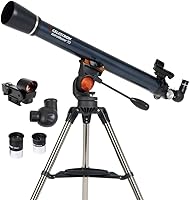
The Celestron Travel Scope 70 is a 70mm refractor with a 45-degree erect-image diagonal, 20mm and 10mm eyepieces, a full-height tripod, and an included backpack.
If you already own a telescope, confirm its design and accessory fit before adding a diagonal. If you want a beginner model that includes the accessory, compare its other features with our beginner telescope picks.
Frequently asked questions
Why is my telescope image upside down?
Telescope lenses and mirrors can invert or rotate an image as they form it, so an upside-down view is normal in many designs. A diagonal can change the orientation again, depending on its type.
This usually doesn't affect astronomy because celestial objects have no fixed upright direction.
Is an upside-down telescope image a problem?
Usually, no. An upside-down or reversed view is expected in many telescopes and works for observing the Moon, planets, and stars.
It matters more for daytime targets such as birds or buildings, where an upright view can make aiming and movement easier.
Does a 90-degree star diagonal make the image upright?
A standard 90-degree star diagonal can make the image appear right side up in a refractor or catadioptric telescope, while reversing left and right. An erect-image diagonal corrects both directions on compatible refractors and Schmidt-Cassegrain telescopes, but it doesn't correct a Newtonian's orientation.
Can I use an erect-image diagonal on a Newtonian telescope?
An erect-image diagonal won't make a Newtonian reflector's view fully upright and left-to-right correct. The Newtonian optical design leaves the image rotated, even with this accessory.
That orientation is generally fine for astronomy, so you don't need an erect-image diagonal just to observe celestial targets.