Gskyer 70mm Telescope Review: Worth It? (November 2026)
The Gskyer 70mm telescope suits beginners who want a portable scope for the Moon and daytime scenery. Its bag, adjustable tripod and phone adapter help with casual viewing and travel, while its 70mm aperture favors bright targets.
On this page (10 sections)
- Is the Gskyer telescope a good choice for beginners?
- What can you see through the Gskyer 70mm?
- How should you choose an eyepiece and magnification?
- How do you set up the Gskyer telescope?
- Can you take phone photos with the Gskyer telescope?
- Which Gskyer telescope alternatives should you consider?
- What are the Gskyer telescope's main limitations?
- How should you care for the Gskyer after observing?
- Which Gskyer telescope should you choose?
- Related reading
The Gskyer 70mm telescope is a portable refractor for beginners who want to view the Moon and daytime scenery. Its 400mm focal length, adjustable aluminum tripod, carry bag and phone accessories make it a practical starter kit for casual observing.
The 70mm aperture is best suited to bright targets, and the light tripod can move as you focus or aim. Choose it for straightforward visual use and simple phone snapshots, not for faint deep-sky objects or long-exposure astrophotography.
Is the Gskyer telescope a good choice for beginners?
The Gskyer telescope is a good fit if you want a compact first scope with a few useful accessories in one kit. It gives you a low-power starting point for finding the Moon, a higher-power eyepiece to compare views, and a finder scope to practice aiming.
The alt-azimuth mount moves up, down and side to side. That familiar motion suits casual viewing, though you must move the telescope by hand to keep an object centered as it crosses the sky.
The carry bag and 5.7 lb telescope weight make storage and transport manageable for many beginners. It can be a reasonable fit for a family observing from the yard, a campsite, or another spot where a full-size setup would be inconvenient.
Skip it if your main goal is detailed views of faint galaxies and nebulae, or if you want a mount that tracks targets automatically. A larger aperture gathers more light, and a simple alt-azimuth mount requires manual adjustments.
Gskyer 70mm AZ Refractor: Best for portable beginners
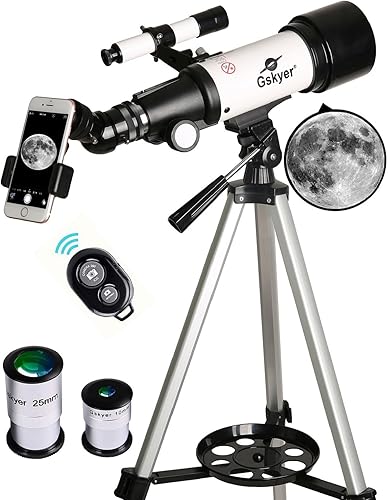
- 70mm aperture
- 400mm focal length
- Alt-azimuth mount
- Carry bag and phone adapter
A compact refractor kit for beginners who want to view the Moon and daytime targets, with a bag and phone adapter included. Its 70mm aperture suits bright targets.
Pros
- Carry bag and adjustable aluminum tripod
- Two eyepieces and a 3x Barlow lens
- Phone adapter and wireless camera remote
- Short 400mm focal length
Cons
- 70mm aperture gathers less light than larger apertures
- High magnification does not guarantee a clear image
- Movement can affect the view
What can you see through the Gskyer 70mm?
The Gskyer 70mm is best matched with bright, easy-to-find targets, especially the Moon. Its aperture works well for learning to focus and aim, but it cannot collect as much light as a larger telescope.
The Moon makes a useful first target because its bright surface and broad features are easier to locate than small planets or faint deep-sky objects. Begin with the 25mm eyepiece, center the Moon, and then switch to the 10mm eyepiece to see whether the view remains sharp and steady.
You can also use the scope for daytime views of distant land features. Keep the target still and far away, and never point the telescope at or near the Sun.
For a more detailed guide to realistic targets, read what you can see with a 70mm telescope. It explains how aperture and target brightness shape the views a beginner can expect.
How should you choose an eyepiece and magnification?
Start with the 25mm eyepiece to find and center your target, then try the 10mm eyepiece for a closer view. With the Gskyer's 400mm focal length, those eyepieces provide about 16x and 40x magnification.
The included 3x Barlow lens triples the magnification of either eyepiece. More magnification also makes vibration, focus errors and atmospheric shimmer more visible, so adding the Barlow is not automatically an improvement.
A common beginner mistake is to begin at the highest power and expect a larger, sharper image. Find the target at low power first, let the view settle after each adjustment, and move to higher power only when the image is clear.
Our guide to telescope eyepieces and what they do explains how eyepiece choice affects viewing. The telescope magnification guide shows how to work out the magnification for different combinations.
How do you set up the Gskyer telescope?
Set the tripod on firm, stable ground, attach the telescope, and check that the mount can move smoothly before you begin. The 5x24 finder scope helps you point the main tube toward a target, but you need to align it first.
Align the finder on a distant daytime object that is well away from the Sun. Center the object in the main telescope, then adjust the finder so its crosshairs point to the same place.
At night, start with the low-power eyepiece and a bright target. Turn the focus wheel slowly, and avoid leaning on the tripod or extending the legs more than the observing position requires.
Take the telescope outside before observing so it can adjust to the outdoor temperature. A temperature difference can cause moisture to condense on the front lens.
Let it acclimate before you begin observing. For a fuller walkthrough, follow our guide on how to set up a telescope for the first time.
Can you take phone photos with the Gskyer telescope?
The Gskyer includes a smartphone adapter and wireless camera remote for taking pictures through the eyepiece. These accessories give beginners a way to try simple photos of bright targets, though a phone image can be less detailed than the view through the eyepiece.
First center the Moon with the 25mm eyepiece. Then attach the phone and adjust its position until the camera lines up with the eyepiece and shows a centered image.
Use the remote to take the photo without touching the telescope. A bump can shift the target out of view, particularly at higher magnification.
The mount does not automatically track the sky, so the Moon may drift while you adjust the phone. The phone adapter is best for casual snapshots rather than long exposures of faint objects.
See what to know before buying a telescope phone adapter for more alignment advice.
Which Gskyer telescope alternatives should you consider?
Choose among these alternatives by comparing the kit you want, the focal length and aperture, and the accessories you expect to use. The Celestron adds a backpack and full-height tripod, while the Koolpte and Celticbird offer 80mm apertures and longer focal lengths.
Celestron Travel Scope 70: Best for backpack travel

- 70mm aperture
- 400mm focal length
- Alt-azimuth mount
- Backpack included
This 70mm refractor has a 400mm focal length, an included backpack, a full-height tripod and no-tool setup. It supports daytime scenery as well as nighttime viewing.
Pros
- Backpack stores the scope and accessories
- Full-height tripod
- No-tool setup
- 20mm and 10mm eyepieces
Cons
- No phone adapter or wireless remote is specified in the product information
- 70mm aperture gathers less light than larger apertures
The Celestron Travel Scope 70 suits you if the included backpack, full-height tripod and no-tool setup matter most. It shares the Gskyer's 70mm aperture and 400mm focal length, but the Gskyer includes the phone adapter and wireless remote.
Koolpte 80mm Refractor: Best for longer focal length

- 80mm aperture
- 600mm focal length
- Alt-azimuth mount
- Carry bag and phone adapter
The 80mm aperture and 600mm focal length make this a longer refractor alternative. It includes a phone adapter, wireless remote and carry bag.
Pros
- 80mm aperture
- 600mm focal length
- Two eyepieces and a 3x Barlow lens
- No-tool setup
Cons
- Longer focal length than the Gskyer
- A steady surface helps keep the view still
The Koolpte 80mm Refractor suits you if you want a longer focal length and an 80mm aperture. It also comes with two eyepieces, a 3x Barlow lens, a phone adapter, a wireless remote and a carry bag.
Celticbird 80mm Refractor: Best for lunar contrast

- 80mm aperture
- 600mm focal length
- Alt-azimuth mount
- Backpack and Moon filter
The Celticbird combines an 80mm aperture and 600mm focal length with a backpack, phone adapter and Moon filter. Consider it if those accessories matter to you.
Pros
- 80mm aperture
- Backpack and phone adapter
- Moon filter included
- Adjustable tripod
Cons
- 600mm focal length
- The 5.8 lb kit weighs more than the Celestron Travel Scope 70
The Celticbird 80mm Refractor offers an 80mm aperture and 600mm focal length, along with a backpack, phone adapter and Moon filter. The filter is for lunar viewing, not solar viewing.
The Gskyer remains the straightforward choice if you prefer its shorter focal length and want the included remote and phone adapter. Compare it with other compact choices in our guide to portable telescopes for travel and small spaces.
What are the Gskyer telescope's main limitations?
The Gskyer's 70mm aperture and manually moved mount favor bright-target viewing over faint objects and long-exposure photos. Those limits matter most if you expect to explore dim targets or want the telescope to follow an object for you.
A larger aperture gathers more light, which helps make dimmer targets easier to observe. City light and haze also reduce contrast, so choosing a darker viewing location can help when one is available.
The tripod may shake when you touch the focus wheel or reposition the tube. Let the image settle after each movement, make small adjustments, and keep the setup on firm ground.
A common mistake is to treat the Barlow's higher magnification as a promise of more detail. The Moon may look blurry at high power if the telescope is out of focus, the mount is moving, or the atmosphere is unsteady.
How should you care for the Gskyer after observing?
Store the tube and tripod in the carry bag when they're dry and ready to pack. If the telescope has been outside in cool or damp air, let the lens and other parts dry before closing the bag.
Avoid touching the front lens, since fingerprints and dust can affect the view. Use care when handling the eyepieces and phone adapter, and keep the parts together so they're ready for the next session.
When an image looks blurred, turn the focus wheel before assuming there is a problem with the telescope. Check that the eyepiece is seated, the target is centered, and the tripod has stopped moving.
Never use the scope to view the Sun, even briefly. The included Moon filter is not a solar filter, and you should not point the telescope at or near the Sun.
Which Gskyer telescope should you choose?
Choose the Gskyer 70mm telescope if you want a portable first scope for the Moon, daytime scenery and occasional phone photos. Its carry bag, tripod and phone accessories fit that use well.
Choose the Celestron Travel Scope 70 if you prefer a backpack and full-height tripod, or consider the Koolpte or Celticbird if an 80mm aperture and longer focal length are priorities. Skip all four if you want a telescope designed around faint deep-sky viewing or automatic tracking.
Before you decide, match the telescope to where you will observe, how you will carry it and the targets you hope to see. Our beginner telescope guide can help you compare other designs.
Related reading
- What you can see with a 70mm telescope
- How to set up a telescope
- Telescope eyepieces explained
- Telescope phone adapters
Frequently asked questions
What can you see with the Gskyer 70mm telescope?
The Gskyer 70mm suits bright targets such as the Moon and can also be used for terrestrial viewing. What you see depends on sky conditions, focus and steadiness; its 70mm aperture gathers less light than larger apertures.
How much magnification does the Gskyer telescope provide?
The Gskyer includes 25mm and 10mm eyepieces and a 3x Barlow lens. Its 400mm focal length gives about 16x and 40x with those eyepieces before the Barlow, which triples each eyepiece's magnification.
Can you take photos with the Gskyer 70mm telescope?
The Gskyer includes a smartphone adapter and wireless camera remote for taking photos through the eyepiece. A phone can record bright targets such as the Moon, though centering a steady image takes adjustment.
Is the Gskyer 70mm telescope portable?
The Gskyer tube and tripod fit in the included carry bag, and the telescope weighs 5.7 lb. This makes the kit suitable for storage and travel, though you may want to check whether its packed size fits your plans.



