8 Best Telescopes for Planets and Deep Space (November 2026)
The best telescopes for planets and deep sky objects include the Celestron NexStar 8SE Computerized Telescope for planets and deep sky in one scope, the DWARFLAB Dwarf Mini Smart Telescope for travel and camping, and the ZWO Seestar S30 Pro Smart Telescope for imaging from a bright city.
On this page (9 sections)
- The best telescopes for planets and deep sky objects
- How these telescopes compare
- How we compared these telescopes for planets and deep space
- Which aperture do you need for planets and deep-sky objects?
- Should you buy a GoTo, smart or manual telescope?
- How much do weight and portability matter?
- Which telescope fits your budget and experience?
- What should you know before your first night?
- Verdict: the best telescope for planets and deep space
The best telescope for planets and deep space is the Celestron NexStar 8SE, because its 8-inch Schmidt-Cassegrain optics gather enough light for Jupiter's cloud bands and distant galaxies, and its GoTo mount finds each target for you. Pick a smart scope for imaging on the road, or a 130mm to 150mm reflector for manual practice at a lower price tier.
A telescope that does both jobs well needs two things: enough aperture to pull faint light from nebulae and galaxies, and a mount steady enough to hold a planet while you look. The picks below balance those needs differently, so the best one for you depends on whether you want to look, image or learn the sky by hand.
Start with our telescope for backyard astronomy guide if your observing happens mostly at home. Readers who want a smaller kit to carry should read the portable telescope picks.
Our picks at a glance
-
1
 Best for planets and deep sky in one scope
Celestron NexStar 8SE Computerized Telescope
9.7/10 our score
See it on Amazon -
2
-
3
 Best for imaging from a bright city
ZWO Seestar S30 Pro Smart Telescope
9.2/10 our score
See it on Amazon
- 4
 Best for a first refractor on a budgetCheck it
- 5
 Check it
Dianfan 150EQ Professional Astronomy Telescope for Adults
Best for manual tracking practice - 6
 Check it
SVBONY SV503 Telescope for Adults High Powered
Best for planetary and deep-sky photos - 7
 Check it
SOLOMARK Telescope 130EQ Newtonian Reflector Telescopes
Best for wide-field deep-sky scanning - 8
 Best for beginners who want a simple manual scopeCheck it
The best telescopes for planets and deep sky objects
The NexStar 8SE is the strongest all-round choice for visual observing, while the smart scopes and manual reflectors each serve a narrower need. Choose by aperture first, then by how much automation you want to learn.
Celestron NexStar 8SE Computerized Telescope: Best for planets and deep sky in one scope
- 8-inch Schmidt-Cassegrain optics
- GoTo mount with 40,000+ object database
- SkyAlign alignment on three bright objects
- 25mm eyepiece included
A large Schmidt-Cassegrain tube on a computerized mount that finds and tracks targets for you. It handles Jupiter's cloud bands and distant galaxies in the same session.
Pros
- 8-inch aperture for both bright and faint targets
- SkyAlign gets you observing in minutes
- 40,000+ object GoTo database
Cons
- Heaviest and bulkiest pick here
- Highest price tier in this group
Celestron's 8-inch Schmidt-Cassegrain tube is the largest aperture in this group, and it shows. The 2032mm focal length reaches high magnifications for lunar craters and Jupiter's cloud bands, while the 8-inch mirror pulls in globular clusters and galaxies that smaller scopes leave faint.
The fully computerized fork mount uses SkyAlign: center any three bright stars or planets, even unnamed ones, and the system works out where it is and aligns in minutes. The NexStar+ hand control then slews to any of 40,000+ objects and tracks it, so the target stays in the eyepiece while you look.
It comes with a 25mm eyepiece and a StarPointer red dot finderscope, and it accepts Celestron accessories like StarSense AutoAlign and SkyPortal WiFi as you grow. The trade-off is weight and bulk: at about 24 lb set up, this is a scope you carry out in one trip to the yard rather than stuff in a daypack.
Buy it if you want one instrument that does planets and deep sky without hunting by hand. Look elsewhere if you need something pocket-sized or you are not ready for the higher price tier.
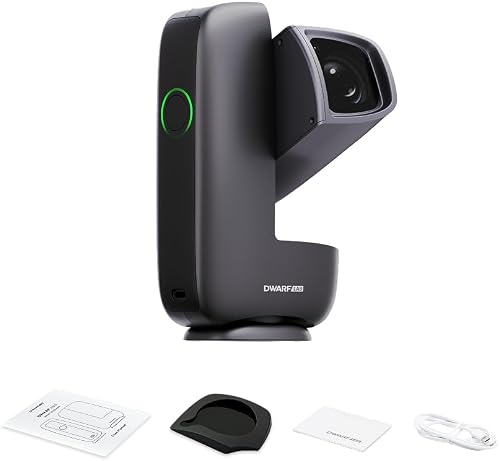
DWARFLAB Dwarf Mini Smart Telescope: Best for travel and camping
- 1.85 lb all-in-one body
- Sony IMX662 sensor
- Auto GOTO with 360-degree pivot
- 90-second single-frame exposures
A pocket-sized digital scope that fits in a backpack and runs from a phone app. Its light pollution filters and long exposures suit deep-sky imaging away from home.
Pros
- Weighs about as much as two soda bottles
- App control with built-in sky atlas
- EQ mode for long exposures
Cons
- Small aperture limits visual brightness
- Not built for close planetary views
The Dwarf Mini suits a traveler who wants deep-sky images from a campsite or a dark-sky field. It weighs about as much as two bottles of soda and fits in a backpack or a large pocket, so it is the easiest scope here to take somewhere.
Its Sony IMX662 sensor and 360-degree pivot handle the pointing. Select a target in the DWARFLAB app and the scope finds and tracks it, then stacks and processes the frames into an image on your phone.
Equatorial mode allows single-frame exposures up to 90 seconds, and the built-in light pollution filters help cut city glow.
For planets, expect small, bright discs rather than fine detail, since its 30mm aperture gathers far less light than the reflectors here. The real strength is faint nebulae and star clusters, where long exposures and stacking make up for the small lens.
Choose it for imaging on the move and family-friendly sky tours. Choose a larger reflector if you mainly want to look at planets through an eyepiece.
ZWO Seestar S30 Pro Smart Telescope: Best for imaging from a bright city
- Dual-camera 4K imaging
- Apochromatic optics
- Built-in light pollution filters
- One-tap Milky Way and star trail modes
A smart scope tuned for astrophotography in urban skies. Its dual camera and filters bring out nebulae and galaxies, while the maker says it is not meant for planetary observation.
Pros
- Apochromatic optics reduce color fringing
- Light pollution filters for city use
- Automatic mosaic stitching for wide fields
Cons
- Maker says it is not intended for planetary observation
- Heavier than the Dwarf Mini
The Seestar S30 Pro is the pick for someone who images from a light-polluted backyard. Its apochromatic optics reduce color fringing for sharper stars, and built-in light pollution filters help pull nebulae out of bright urban skies.
The dual-camera setup delivers 4K-quality images, and one-tap modes cover the Milky Way, star trails, nebulae, galaxies, the Moon and the Sun. Automatic mosaic stitching makes wide-field shots easier, and AI processing cleans up noise after the capture.
It weighs 3.6 lb, so it is still easy to carry outside or pack for a trip.
Here is the catch: ZWO says the S30 Pro is designed for deep-sky objects and is not intended for planetary observation. If planets are half of your plan, the NexStar 8SE or a 130mm reflector fits better.
Buy it for deep-sky imaging from a city or a balcony. Skip it if you want close-up views of Jupiter and Saturn.
HUGERSTAR Telescope: Best for a first refractor on a budget
- 90mm aperture, 800mm focal length
- 32x to 240x magnification
- Phone adapter and moon filter
- Adjustable stainless steel tripod
A refractor kit that covers lunar and planetary viewing with a phone adapter and moon filter in the box. The 90mm lens gathers enough light for bright deep-sky targets.
Pros
- Everything needed to start observing is included
- Moon filter helps tame lunar glare
- Carrying bag for storage and travel
Cons
- Manual altazimuth mount, no tracking
- Smaller aperture than the 130mm reflectors here
The HUGERSTAR refractor is a complete starter kit for someone who wants to see the Moon and planets first. Its 90mm aperture and 800mm focal length give crisp lunar views, and the included moon filter tames glare on a bright full Moon.
Two eyepieces (10mm and 25mm) plus a 3X Barlow lens take you from 32x to 240x, enough to see Jupiter's moons and Saturn's rings on a steady night. The 5x24 finder scope helps you aim, and the adjustable stainless steel tripod fits different heights.
A phone adapter lets you snap pictures, and a carrying bag makes storage and travel easier.
Its 90mm lens is the smallest aperture among the manual scopes here, so faint galaxies and nebulae look dimmer than they do in the 130mm to 150mm reflectors. The mount is a simple altazimuth type with no tracking, so you nudge the scope to follow objects.
Buy it as a first refractor for lunar and planetary viewing with photos. Move up to a reflector if deep-sky objects are your main draw.
Dianfan 150EQ Professional Astronomy Telescope for Adults: Best for manual tracking practice
- 150mm aperture, 650mm focal length
- German-style equatorial mount
- Slow-motion control cables
- Phone adapter and carry bag
A 150mm reflector on an equatorial mount with slow-motion controls. It gives the most light gathering of the manual picks and lets you learn to follow objects by hand.
Pros
- Largest aperture among the manual scopes here
- Equatorial mount tracks objects with one axis adjustment
- Carry bag and phone adapter included
Cons
- Setup takes about 20 minutes for beginners
- Equatorial alignment takes practice
The Dianfan 150EQ is for a buyer who wants the most light gathering without paying for electronics. Its 150mm aperture is the largest among the manual picks, and the 650mm focal length gives a wide field for sweeping clusters and nebulae.
The German-style equatorial mount is pre-assembled, and slow-motion control cables let you follow a planet smoothly as it drifts. Once you align the mount, a single axis adjustment keeps a target in view.
The kit includes a red dot finderscope, a phone adapter and a carry bag, and the stainless steel tripod adjusts from 48.4 to 66.2 inches.
Setup takes about 20 minutes for a beginner, and learning the equatorial alignment adds a little practice. The 2x Barlow and two eyepieces reach 26x to 130x, which is comfortable for lunar detail and planetary views.
Buy it if you want manual control and the biggest mirror in the manual group. Choose a GoTo scope if you would rather the mount do the finding.
SVBONY SV503 Telescope for Adults High Powered: Best for planetary and deep-sky photos
- 102mm ED refractor, f/7
- S-FPL51 ED glass reduces color fringing
- Dual-speed focuser and 360-degree field rotator
- Retractable lens hood
An ED refractor optical tube for buyers who want sharp color and easy camera alignment. It delivers crisp planetary and deep-sky images but needs a mount sold separately.
Pros
- ED glass keeps star colors clean
- Dual-speed focuser holds critical focus
- Field rotator aids camera framing
Cons
- Sold as an optical tube only, no mount included
- Smaller light grasp than the 150mm reflectors
The SV503 is an ED refractor optical tube for someone who wants clean color in planetary and deep-sky photos. Its S-FPL51 ED glass reduces color fringing, so star colors stay true and detail holds up under magnification.
The dual-speed focuser lets you make fine adjustments and keep critical focus, while the 360-degree field rotator aligns your camera without rotating the tube. A 133mm retractable lens hood blocks stray light and helps prevent dew.
The 102mm aperture and f/7 focal length balance brightness with a flat field for imaging.
It is sold as an optical tube only, with rings and a dovetail plate but no mount or tripod. That makes it the most flexible imaging platform here, but you need to supply a mount that can carry it.
For visual planetary work it also needs an eyepiece and diagonal.
Pick it for astrophotography and high-quality planetary views once you have a mount. Skip it if you want a ready-to-observe package.
SOLOMARK Telescope 130EQ Newtonian Reflector Telescopes: Best for wide-field deep-sky scanning
- 130mm aperture, 650mm focal length
- German equatorial mount with slow-motion cables
- 1.5X Barlow lens and 13% moon filter
- Phone adapter included
A 130mm Newtonian that balances aperture and price. The wide field helps you sweep star clusters and nebulae, and the kit includes a moon filter and phone adapter.
Pros
- Wide field suits sweeping the Milky Way
- Full accessory kit in the box
- Equatorial mount aids manual tracking
Cons
- Manual tracking only
- Newtonian design needs collimation upkeep
The SOLOMARK 130EQ balances aperture and kit completeness for wide-field deep-sky scanning. Its 130mm Newtonian gathers enough light for bright nebulae and star clusters, and the 650mm focal length gives a wide field that makes sweeping the Milky Way satisfying.
The German equatorial mount has dials and slow-motion cables, so you can track objects by hand after aligning it. A 1.5X erecting Barlow lens and a 13% transmission moon filter come in the box, along with a smartphone adapter.
The carbon-fiber-look tube keeps the weight manageable, and the aluminum tripod has a storage tray.
It is a manual scope, so expect to find targets yourself and nudge the tube to follow them. The Newtonian design also means occasional collimation to keep the mirror aligned.
For the price tier, it packs a lot into one box.
Buy it for wide-field visual scanning and easy phone photos. Pass on it if you want GoTo pointing or the sharpest planetary contrast.
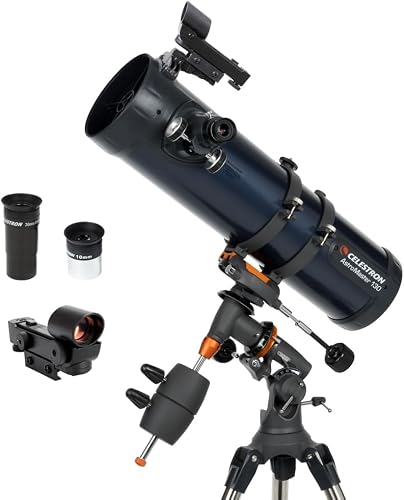
Celestron AstroMaster 130EQ: Best for beginners who want a simple manual scope
- 130mm Newtonian reflector
- German equatorial mount with slow-motion knobs
- 20mm and 10mm eyepieces
- StarPointer red dot finderscope
A straightforward 130mm reflector from a long-running brand. It shows lunar craters, Saturn's rings and bright deep-sky objects without electronics or app setup.
Pros
- Simple setup with no tools needed
- Celestron backs it with a 2-year US warranty
- Slow-motion knobs for smooth centering
Cons
- No GoTo or tracking electronics
- Lowest score here for imaging ambitions
The Celestron AstroMaster 130EQ is a simple manual scope for a beginner who wants to learn the sky without apps or batteries. Its 130mm Newtonian mirror shows lunar craters, Saturn's rings and bright deep-sky objects, and the German equatorial mount has slow-motion knobs for smooth centering.
The kit includes a 20mm eyepiece with a built-in erect image corrector and a 10mm eyepiece, plus a StarPointer red dot finderscope. Celestron backs it with a 2-year US warranty and includes a download of astronomy software.
Assembly takes minutes with no tools.
The lack of GoTo or tracking electronics means you find targets yourself and keep nudging to follow them. Its mirror coating and optics are solid for the price tier, but it trails the 8-inch SCT and the 150mm reflector on light gathering.
It also gives the least headroom for imaging ambitions.
Choose it as a low-cost manual starter that grows your star-hopping skills. Look at the NexStar 8SE if automation matters more than simplicity.
How these telescopes compare
The table lines up aperture, focal length and mount type so you can see why the NexStar 8SE wins overall and where each smart or manual scope fits. Aperture decides how much faint light reaches your eye or sensor, while mount type decides how much work you do to find and follow targets.
| Product | Best for | Aperture | Focal length | Mount | Our score |
|---|---|---|---|---|---|
| Celestron NexStar 8SE Computerized Telescope | planets and deep sky in one scope | 8 in | 2032mm | Computerized altitude-azimuth single fork arm | 9.7 |
| DWARFLAB Dwarf Mini Smart Telescope | travel and camping | 30mm | 150mm | 9.3 | |
| ZWO Seestar S30 Pro Smart Telescope | imaging from a bright city | 30mm | 160mm | 9.2 | |
| HUGERSTAR Telescope | a first refractor on a budget | 90mm | 800mm | Altazimuth | 8.7 |
| Dianfan 150EQ Professional Astronomy Telescope for Adults | manual tracking practice | 150mm | 650mm | Equatorial | 8.5 |
| SVBONY SV503 Telescope for Adults High Powered | planetary and deep-sky photos | 102mm | 714mm | Tripod mount (optical tube only) | 8.3 |
| SOLOMARK Telescope 130EQ Newtonian Reflector Telescopes | wide-field deep-sky scanning | 130mm | 650mm | Equatorial | 8.1 |
| Celestron AstroMaster 130EQ | beginners who want a simple manual scope | 130mm | 650mm | Equatorial | 7.5 |
How we compared these telescopes for planets and deep space
We compared specs and features, not eyepiece time. Our score weighs aperture and focal length against the two jobs here: resolving planetary detail and pulling in faint deep-sky light.
Mount type came next, since GoTo and tracking save time for beginners while manual equatorial mounts cost less. We also looked at what each kit includes, how much it weighs for carrying, and how well its imaging features fit astrophotography.
The scores spread from 7.5 to 9.7 to reflect those differences.
Which aperture do you need for planets and deep-sky objects?
About 130mm is the practical floor for seeing both well. An 8-inch scope like the NexStar 8SE gathers more light and shows finer planetary detail and dimmer galaxies.
Below 130mm, bright planets and the Moon still look good, but faint deep-sky objects get hard to see.
What 130mm to 150mm reflectors give you
The Dianfan 150EQ and the two 130mm reflectors here sit in the sweet spot for a first serious scope. They gather enough light for globular clusters and bright nebulae while keeping the tube light enough to carry.
The 150mm Dianfan has the most light grasp of the manual group.
What an 8-inch Schmidt-Cassegrain adds
The NexStar 8SE's 8-inch aperture and 2032mm focal length reach high magnifications and bring out detail on Jupiter and Saturn. It also shows galaxies and nebulae that smaller scopes leave as faint smudges.
The price is a heavier tube and a higher price tier.
Should you buy a GoTo, smart or manual telescope?
GoTo and smart scopes find targets for you; manual scopes ask you to do the hunting. Pick GoTo if you want to spend your time looking, smart if you want images on your phone, and manual if you want to learn the sky and save money.
GoTo mounts like the NexStar 8SE
A GoTo mount aligns on a few bright stars and then slews to any object in its database. The NexStar 8SE tracks 40,000+ targets.
It suits a beginner who gets frustrated hunting and wants the scope to do the pointing.
Smart telescopes like the Dwarf Mini and Seestar S30 Pro
Smart scopes run from an app and process images for you. The Dwarf Mini fits in a backpack and the Seestar S30 Pro is tuned for city imaging.
Both are best for deep-sky photos, and the Seestar's maker says it is not meant for planetary observation.
Manual equatorial scopes like the Dianfan and SOLOMARK
Manual equatorial mounts track objects by hand once aligned. They cost less than GoTo scopes and teach you the sky.
Pick one if you enjoy the process and want the most aperture for your budget.
How much do weight and portability matter?
Weight decides whether you actually take the scope outside. The Dwarf Mini at about 1.9 lb and the Seestar S30 Pro at 3.6 lb are easy to carry, while the NexStar 8SE at about 24 lb set up is a backyard instrument.
The reflectors fall in between.
Backyard scopes vs travel scopes
The NexStar 8SE and the 130mm to 150mm reflectors suit a yard or a deck where you set up and stay put. The two smart scopes suit a balcony, a campsite or a dark-sky trip.
Our portable telescope picks cover the carry-friendly options in more detail.
What to check before you carry a scope outdoors
Check the total weight with the mount and tripod, not just the tube. A 130mm reflector on an equatorial mount can weigh 15 to 20 lb set up.
Leave a few minutes to align and let the optics settle before you start viewing.
Which telescope fits your budget and experience?
Match the scope to what you want to do first. A beginner who wants photos and planets should start with the HUGERSTAR refractor kit, while a buyer chasing faint galaxies should save for more aperture.
The telescope for the money guide compares value across price tiers.
Best value for a first telescope
The HUGERSTAR refractor kit covers the Moon and planets with a phone adapter and moon filter in the box. It is the easiest entry point here.
For a manual reflector with more light grasp, the SOLOMARK 130EQ adds a Barlow lens and moon filter.
When to spend more for aperture and automation
Move up to the NexStar 8SE when faint deep-sky objects and easy pointing matter. Its 8-inch aperture and GoTo mount do both jobs without you hunting.
The smart scopes sit in between on price and simplify imaging.
Refractor or reflector for planets and deep sky?
A refractor telescope like the HUGERSTAR or SVBONY gives sharp, color-clean views and needs no collimation. A reflector gives more aperture for the price and suits faint targets.
The SV503 ED refractor is the best imaging choice if you already own a mount.
What should you know before your first night?
Plan for alignment and settling time, and set up away from streetlights. Most scopes here need a few minutes to align or cool down before the view is sharp.
A red flashlight and a star chart or app help you find targets.
Alignment and cooling time
SkyAlign on the NexStar 8SE takes a few minutes on three bright objects. Equatorial mounts like the Dianfan and SOLOMARK need polar alignment, which takes practice.
Let a reflector's mirror reach the outdoor temperature before high-magnification viewing.
Eyepieces, filters and phone adapters
The HUGERSTAR, SOLOMARK and Dianfan kits include eyepieces and a phone adapter. The NexStar 8SE comes with a 25mm eyepiece.
A moon filter helps on bright nights. The smart scopes handle imaging through their apps without separate eyepieces.
Verdict: the best telescope for planets and deep space
The NexStar 8SE is the best telescope for planets and deep space for most people, because its 8-inch optics and GoTo mount handle bright and faint targets in one instrument. Pick the Dwarf Mini for travel imaging or the Seestar S30 Pro for city astrophotography.
Choose the HUGERSTAR for a budget first refractor, or the Dianfan 150EQ for manual tracking practice. For more on setting up a home scope, read our backyard astronomy guide.
Our top 3 picks at a glance
-
1
Best for planets and deep sky in one scope
Celestron NexStar 8SE Computerized Telescope
9.7/10 our score
See it on Amazon -
2
-
3
Best for imaging from a bright city
ZWO Seestar S30 Pro Smart Telescope
9.2/10 our score
See it on Amazon
Frequently asked questions
Can a smart telescope show planets and deep space?
Smart telescopes are built mainly for deep-sky imaging. The ZWO Seestar S30 Pro's maker says it is not intended for planetary observation.
The DWARFLAB Dwarf Mini can capture bright planets, but its 30mm lens will not match a larger reflector for planetary detail.
Is GoTo worth it for a beginner?
Yes, if you want to spend your time looking rather than hunting. GoTo mounts find and track targets from a large database.
Manual equatorial scopes cost less but take practice to aim and follow objects as the sky moves.
How heavy is a telescope I can carry outside?
The DWARFLAB Dwarf Mini weighs about 1.9 lb and fits in a backpack. The NexStar 8SE weighs about 24 lb fully set up.
Choose by how far you need to carry it and whether you will travel with it.
Do I need a moon filter for planetary viewing?
A moon filter helps when the full Moon is too bright to view comfortably. Several kits here include a 13% transmission moon filter.
For Jupiter and Saturn, use higher magnification instead of dimming the view.


