8 Best Telescopes for Backyard Astronomy (November 2026)
The best backyard astronomy telescopes include the Celestron StarSense Explorer LT 114AZ for guided backyard sessions, the Sky-Watcher Heritage 130 Tabletop Dobsonian for simple tabletop viewing, and the Celestron StarSense Explorer 130mm Tabletop for app-guided tabletop viewing.
On this page (5 sections)
The Celestron StarSense Explorer LT 114AZ is the best telescope for backyard astronomy for most beginners because its app helps locate targets and its tripod supports viewing without a table. For a larger tabletop reflector, choose the Sky-Watcher Heritage 130; for guided tripod viewing, consider the StarSense Explorer DX 130AZ.
Backyard observing rewards a telescope you'll actually set up. Think about where you'll store it, whether you have a stable table, and how much help you want finding objects before comparing aperture alone.
Our beginner telescope picks cover easy first choices, while the portable telescope guide helps if you need to move your scope between storage and the yard. If the Moon is your main target, see our guide to telescopes for Moon viewing.
Our picks at a glance
-
1
 Best for guided backyard sessions
Celestron StarSense Explorer LT 114AZ
8.8/10 our score
See it on Amazon -
2
 Best for simple tabletop viewing
Sky-Watcher Heritage 130 Tabletop Dobsonian
8.5/10 our score
See it on Amazon -
3
 Best for app-guided tabletop viewing
Celestron StarSense Explorer 130mm Tabletop
8.2/10 our score
See it on Amazon
- 4
 Check it
Celestron StarSense Explorer DX 130AZ
Best for tripod-based app guidance - 5
 Check it
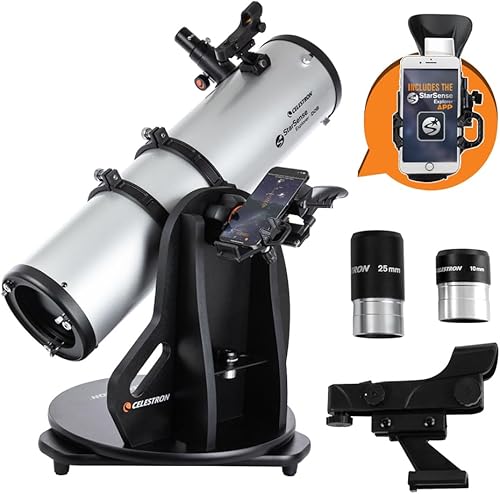
Celestron StarSense Explorer 150mm Tabletop
Best for larger tabletop aperture - 6
 Best for equatorial mount learnersCheck it
- 7
 Best for a bundled accessory kitCheck it
- 8
 Best for compact equatorial storageCheck it
How to choose the best telescope for backyard astronomy
The best backyard telescope balances usable aperture, setup effort and a mount that fits your observing spot. We compared the stated optics, mount types, included accessories and target-finding features of these 8 models.
A bigger mirror can gather more light, but it only helps if the telescope is steady and convenient enough to use. Give extra thought to the support surface, storage location and amount of help you want finding targets.
For quick, guided sessions, a StarSense model offers app-based sky recognition and on-screen arrows. A tabletop Dobsonian keeps the controls direct and the package compact, while an equatorial model suits someone willing to learn its orientation and controls.
Compare backyard telescopes by aperture and mount
Aperture and mount style make a useful first comparison, but your available support and setup preference matter just as much. The table summarizes the main differences among the picks.
| Product | Best for | Aperture | Mount | Included eyepieces | Our score |
|---|---|---|---|---|---|
| Celestron StarSense Explorer LT 114AZ | guided backyard sessions | 114mm | Manual altazimuth with altitude slow motion | 25mm and 10mm | 8.8 |
| Sky-Watcher Heritage 130 Tabletop Dobsonian | simple tabletop viewing | 130mm | Tabletop Dobsonian | 10mm and 25mm | 8.5 |
| Celestron StarSense Explorer 130mm Tabletop | app-guided tabletop viewing | 130mm | Tabletop Dobsonian-style base | 25mm and 10mm | 8.2 |
| Celestron StarSense Explorer DX 130AZ | tripod-based app guidance | 130mm | Manual altazimuth with dual-axis slow motion | 25mm and 10mm | 8.1 |
| Celestron StarSense Explorer 150mm Tabletop | larger tabletop aperture | 150mm | Tabletop Dobsonian base | 25mm and 10mm | 8.0 |
| Celestron AstroMaster 130EQ | equatorial mount learners | 130mm | German equatorial | 20mm and 10mm | 7.5 |
| MEEZAA 150EQ Newtonian | a bundled accessory kit | 150mm | German equatorial | 7.0 | |
| Celestron PowerSeeker 127EQ | compact equatorial storage | 127mm | Manual German equatorial | 20mm and 4mm | 7.0 |
Best telescopes for backyard astronomy by setup
The top pick combines app guidance with a tripod, while the other models suit different space, aperture and mount preferences. Match the telescope to the place where you'll observe most often.
Celestron StarSense Explorer LT 114AZ: Best for guided backyard sessions
- 114mm Newtonian reflector
- Smartphone sky recognition guidance
- Manual altazimuth mount with altitude slow motion
- 25mm and 10mm eyepieces
Phone guidance and a 114mm reflector make this a flexible first backyard telescope. The manual mount keeps operation direct while the app helps you locate targets.
Pros
- App identifies targets using sky patterns
- Includes two eyepieces and a 2x Barlow lens
- Tripod and mount arrive preassembled
Cons
- Needs a compatible smartphone for StarSense guidance
- Manual mount requires you to follow and recenter targets
The StarSense Explorer LT 114AZ is a practical first choice when finding targets feels like the biggest hurdle. Its app analyzes star patterns and uses on-screen arrows to help you point toward selected objects.
The 114mm Newtonian reflector is described for views of the Moon, Jupiter, Saturn, the Orion Nebula and Andromeda. The app also suggests targets based on time and location, giving a beginner a concrete place to start on a clear night.
The manual altazimuth mount has an altitude slow-motion adjustment. It includes 25mm and 10mm eyepieces, a 2x Barlow lens, a StarPointer finder and a full-height tripod.
This model fits a backyard where you want phone guidance and a standing-height setup. Skip it if you don't have a compatible smartphone or prefer a fully manual experience without relying on an app.
Sky-Watcher Heritage 130 Tabletop Dobsonian: Best for simple tabletop viewing
- 130mm aperture
- Collapsible tabletop Dobsonian design
- Fully assembled
- 10mm and 25mm eyepieces
A 130mm aperture and compact tabletop base suit a backyard with a sturdy table or outdoor bench. Its fully assembled design reduces setup steps.
Pros
- Over 5 inches of aperture
- Compact package combines base and tube
- Includes two eyepieces and a red dot finder
Cons
- Needs a stable raised surface
- No phone guided target finding
The Heritage 130 suits a backyard with a steady table or bench and an interest in a straightforward manual telescope. Its 130mm aperture is larger than the 114mm StarSense LT, and its compact tabletop package combines the base and optical tube.
It arrives fully assembled and includes 10mm and 25mm eyepieces plus a red dot finder. Initial setup is simple, but you'll need to supply a stable raised surface at a comfortable height.
The Dobsonian base moves by hand, so pointing is direct. There is no phone-guided target system, so use a basic star chart or astronomy app if you're still learning the sky.
Choose the Heritage 130 if you want a compact tabletop format and already have a suitable support surface. Skip it if you need a telescope that stands on the ground.
Our Dobsonian vs refractor guide explains how these designs differ in everyday use.
Celestron StarSense Explorer 130mm Tabletop: Best for app-guided tabletop viewing
- 130mm Newtonian reflector
- StarSense smartphone guidance
- Tabletop Dobsonian-style base
- 25mm and 10mm eyepieces
This tabletop reflector pairs 130mm aperture with StarSense app guidance. It suits backyard observers who can set the base on a steady surface and want help finding objects.
Pros
- App suggests targets for your time and location
- Includes two eyepieces and a StarPointer finder
- Compact base is easy to transport
Cons
- Requires a table or other stable support
- Smartphone guidance depends on app compatibility
The Celestron StarSense Explorer 130mm Tabletop fits backyard users who want a larger aperture and app guidance in one compact setup. Its 130mm Newtonian reflector sits on a tabletop Dobsonian-style base.
The StarSense app suggests targets for your time and location, then guides you with on-screen arrows. You still move the telescope by hand, but you can begin with a suggested target instead of searching at random.
Two eyepieces, a StarPointer red dot finder and a phone dock are included. Set the base on a firm, level surface before observing, and confirm your phone's compatibility with the app.
Choose this if you have a table ready and value guided target finding. Skip it if you don't have a steady support surface; the tripod-mounted DX 130AZ is a better layout for a bare patio or yard.
Celestron StarSense Explorer DX 130AZ: Best for tripod-based app guidance
- 130mm Newtonian reflector
- StarSense smartphone guidance
- Full-height tripod
- Dual-axis slow-motion controls
The full-height tripod avoids the need for a table, while app guidance and dual-axis slow-motion controls support manual target finding and adjustment.
Pros
- Tripod and mount arrive preassembled
- App uses sky recognition to help find objects
- Includes two eyepieces
Cons
- Requires a compatible smartphone for StarSense guidance
- Tripod takes more storage space than a tabletop base
The StarSense Explorer DX 130AZ offers the same 130mm aperture and phone guidance in a tripod setup. Its dual-axis slow-motion controls give you fine manual adjustments after the app points you toward a target.
The full-height tripod suits a patio or yard where a table isn't available. The mount and tripod arrive preassembled, and the package includes 25mm and 10mm eyepieces, an accessory tray, a red dot finder and the StarSense phone dock.
The app helps identify a target, but you move the telescope yourself. The tripod takes more storage space than a tabletop base, so measure your storage area before choosing it.
Pick the DX 130AZ if you want guided finding, a full-height tripod and slow-motion controls. Skip it if storage space is very limited or your priority is the most compact setup.
Our guide to setting up a telescope for the first time covers basic assembly and alignment.
Celestron StarSense Explorer 150mm Tabletop: Best for larger tabletop aperture
- 150mm Newtonian reflector
- StarSense smartphone guidance
- Tabletop Dobsonian-style base
- 25mm and 10mm eyepieces
A 150mm reflector offers the largest aperture among these tabletop picks. StarSense guidance adds help finding targets, though the base still needs a stable support.
Pros
- Largest aperture among these picks
- App suggests targets for the observing location
- Includes two eyepieces and a phone dock
Cons
- Needs a stable table or other raised surface
- Heavier than the 130mm tabletop option
The StarSense Explorer 150mm Tabletop has the largest aperture among these picks, with a 150mm Newtonian reflector and phone-guided target finding. It suits a backyard observer who wants more aperture in a tabletop format and has a stable surface ready.
The app suggests objects for the current time and location, while the Dobsonian-style base moves manually. It includes 25mm and 10mm eyepieces, a red dot finder, an eyepiece rack and a phone dock.
At 25 lb, it is less convenient to carry than the 130mm tabletop option. A dedicated observing table or sturdy bench can make setup more predictable than moving furniture for each session.
Choose it for the largest stated aperture among these picks. Skip it if you expect to carry the telescope often or don't have a suitably solid support.
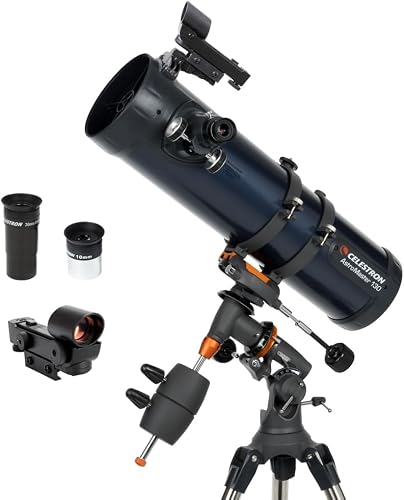
Celestron AstroMaster 130EQ: Best for equatorial mount learners
- 130mm Newtonian reflector
- German equatorial mount
- Right ascension and declination controls
- 20mm and 10mm eyepieces
This tripod mounted 130mm reflector suits backyard observers who want slow-motion controls on an equatorial mount. It includes a red dot finder and astronomy software.
Pros
- Slow-motion controls on both axes
- Adjustable full-height tripod
- Includes two eyepieces and astronomy software
Cons
- Equatorial setup has more steps than a simple altazimuth base
- Does not include phone based StarSense guidance
The AstroMaster 130EQ suits observers who want to learn an equatorial mount and use a full-height tripod. Its 130mm reflector is paired with right ascension and declination slow-motion controls for manual adjustments.
The mount takes more learning than a tabletop Dobsonian or simple altazimuth design. Once you understand its orientation, its controls let you make slow, precise adjustments as an object appears to drift across the sky.
The kit includes a 20mm eyepiece with an erect image corrector, a 10mm eyepiece and a StarPointer finder. Celestron also includes a download of astronomy software for planning sessions.
Choose it if learning equatorial controls is part of your goal. Skip it if you want the simplest possible first night; an app-guided altazimuth telescope will be easier to start using.
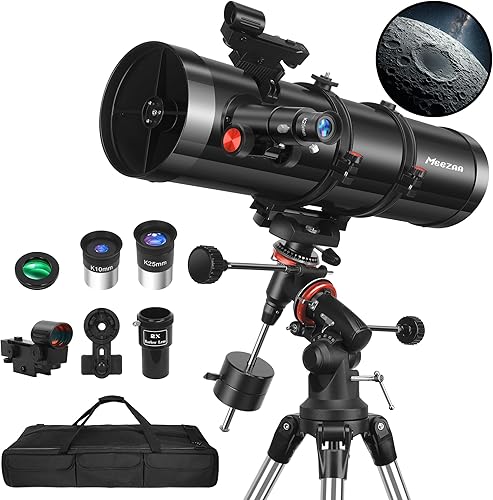
MEEZAA 150EQ Newtonian: Best for a bundled accessory kit
- 150mm aperture and 650mm focal length
- German equatorial mount
- 25mm and 10mm eyepieces with 2x Barlow
- Carry bag and phone adapter
This 150mm reflector includes several accessories for backyard observing, including a phone adapter and carry bag. Its equatorial mount uses manual slow-motion controls.
Pros
- 150mm aperture
- Includes carry bag and phone adapter
- Eyepieces and Barlow cover stated 26x to 130x magnification
Cons
- Equatorial mount takes more setup than an altazimuth mount
- Brand support and warranty details need checking before purchase
The MEEZAA 150EQ combines a 150mm aperture with an equatorial mount and a broad accessory set. The package includes a carry bag, phone adapter, Moon filter, two eyepieces and a 2x Barlow lens.
Its 650mm focal length and included eyepieces provide a stated magnification range of 26x to 130x. The manual mount has slow-motion controls, and the adjustable tripod includes an accessory tray.
The included pieces give you several ways to observe, but a new user will have more choices to learn. Start with the 25mm eyepiece at lower magnification to find targets, then try higher power when the image is steady.
Choose it if you want a carry bag and phone adapter in the same kit. Skip it if you don't want to learn an equatorial mount, or if you need clear warranty and support terms before buying.
Celestron PowerSeeker 127EQ: Best for compact equatorial storage
- 127mm Newtonian reflector
- Manual German equatorial mount
- 20mm and 4mm eyepieces with 3x Barlow
- Compact and portable design
The 127mm reflector gives backyard beginners a tripod mounted option with slow-motion controls. Its included eyepieces and Barlow provide several stated magnification combinations.
Pros
- Compact and portable design
- Includes two eyepieces and a 3x Barlow
- Slow-motion controls for tracking
Cons
- Equatorial mount takes practice to set up
- A 4mm eyepiece with a Barlow may be more power than backyard conditions support
The PowerSeeker 127EQ is a compact tripod-mounted reflector for backyard users who want an equatorial mount and included accessories. Its 127mm Newtonian reflector comes with 20mm and 4mm eyepieces plus a 3x Barlow lens.
Slow-motion controls help move the telescope and follow objects. An equatorial mount has more setup steps than an altazimuth design, so allow time to learn its orientation before planning a quick observing session.
The 4mm eyepiece and Barlow combination creates very high magnification. Start with the 20mm eyepiece, since lower power makes it easier to find and center a target.
Choose the PowerSeeker if compact storage and a traditional equatorial setup suit you. Skip it if you want a guided start or expect to use the highest magnification every session.
What to check before choosing a backyard telescope
Choose a telescope by how you'll set it up and what you'll observe most, then use aperture as a comparison point. A suitable scope needs a steady base, a clear view of the sky and room to use its controls.
Does backyard astronomy need a large aperture?
A larger aperture can gather more light, but it doesn't remove the effects of light pollution or a shaky support. The models here range from 114mm to 150mm, so consider whether the larger telescope fits your storage and observing space.
The Moon and bright planets are useful targets from many yards. Faint galaxies and nebulae are harder to see under bright skies, even when a telescope has a larger mirror.
Is a tabletop or tripod telescope better for a backyard?
A tabletop telescope is compact and quick to place, but it needs a sturdy raised surface. A tripod scope stands on the ground and may offer more comfortable viewing without rearranging patio furniture.
Measure the space where you'll store the complete telescope, including its tube and mount. If you need to carry it through a narrow doorway or down steps, consider the complete setup instead of only the optical tube.
Should backyard stargazers choose phone guidance or a manual mount?
Phone guidance can make early sessions easier by helping you locate targets. The StarSense models in this roundup use sky recognition and on-screen arrows, but you still move the telescope manually.
A manual Dobsonian base is simple to point, but it doesn't identify objects for you. Equatorial mounts add slow-motion controls and require you to learn how to orient them.
What can you see from a backyard?
You can view the Moon and bright planets, as well as some brighter star clusters and deep-sky objects. Local sky brightness, clouds, haze and nearby lights affect how much detail you'll see.
Start with the Moon or a bright planet, then try an open cluster or a bright nebula when conditions allow. Our guide to what a 70mm telescope can show offers a useful baseline for smaller aperture.
How should you set up for a backyard session?
Set the telescope on a firm, level surface with a clear view above nearby roofs and trees. Give the optics time to adjust to outdoor temperatures when needed, and begin with the lowest-power eyepiece to make targets easier to locate.
Keep your observing area clear of direct porch lights and give your eyes time to adjust to the dark. If you're new to the controls, practice during daylight by aiming at a distant object, never at the Sun.
What common mistakes should backyard astronomers avoid?
Don't assume a high-power eyepiece is the best way to begin. Higher magnification narrows the view and makes targets harder to find, so start with the lower-power eyepiece and switch only after centering the object.
Don't set a tabletop telescope on a flexible card table or a surface that can rock. A small shake makes viewing frustrating, so choose a solid bench or outdoor table and avoid touching the support while looking through the eyepiece.
Don't point a telescope at the Sun without proper solar equipment. These models are intended for night-sky observing; keep the telescope pointed away from the Sun.
Which telescope is best for backyard astronomy?
Choose the StarSense Explorer LT 114AZ if phone guidance and a tripod make your first sessions easier. Pick the Heritage 130 if you want a simple tabletop scope and have a solid surface, or the StarSense DX 130AZ if you prefer app guidance with a full-height tripod.
For more aperture in a tabletop format, consider the StarSense 150mm. If learning an equatorial mount matters more than guided target finding, compare the AstroMaster 130EQ, MEEZAA 150EQ and PowerSeeker 127EQ.
The right choice is the one that fits your yard, storage space and patience for setup. Use our beginner telescope guide to compare other easy first scopes before deciding.
Our top 3 picks at a glance
-
1
Best for guided backyard sessions
Celestron StarSense Explorer LT 114AZ
8.8/10 our score
See it on Amazon -
2
Best for simple tabletop viewing
Sky-Watcher Heritage 130 Tabletop Dobsonian
8.5/10 our score
See it on Amazon -
3
Best for app-guided tabletop viewing
Celestron StarSense Explorer 130mm Tabletop
8.2/10 our score
See it on Amazon
Frequently asked questions
What is the best telescope for backyard astronomy?
The best choice depends on whether you value guided target finding, aperture or compact storage. The Celestron StarSense Explorer LT 114AZ is a strong first option because its app helps locate objects and its tripod does not need a table.
Choose a tabletop Dobsonian if you have a steady raised surface and want a compact base.
Is a tabletop Dobsonian good for a backyard?
Yes, a tabletop Dobsonian can work well in a backyard if you have a stable table, bench or similar support. Its base moves by hand, so you can point it without setting up an equatorial mount.
The Sky-Watcher Heritage 130 is fully assembled and includes two eyepieces.
Should I choose a telescope with a phone app?
A phone-guided telescope can help you find targets if you are new to the night sky. StarSense models analyze star patterns and show on-screen arrows toward selected objects.
You still aim and move the telescope by hand, and the app requires a compatible smartphone.
Can I use a telescope from a light-polluted backyard?
Yes. The Moon and planets remain useful targets from many urban and suburban yards, though bright skies make faint deep-sky objects harder to see.
Choose a clear view away from nearby lights and let your eyes adjust to the dark.
Our guide to using a telescope in the city covers practical limits.
How much aperture do I need for backyard stargazing?
Aperture affects how much light a telescope can gather, but setup and sky conditions matter too. The picks here range from 114mm to 150mm, with larger options often needing more room or a sturdy support.
If portability matters, compare the base and tripod along with the aperture.