8 Best Telescopes for Seeing Jupiter (November 2026)
The best telescopes for viewing Jupiter and its moons include the ToyerBee Telescope for Adults & Kids for most beginners, the Dianfan 150EQ Professional Astronomy Telescope for detail and tracking, and the Bushnell Refractor 600x50mm Telescope for simple grab-and-go sessions.
On this page (9 sections)
- Best telescopes for seeing Jupiter and its moons
- How these telescopes compare for Jupiter viewing
- How we chose these telescopes
- What aperture do you need to see Jupiter's cloud bands?
- Which mount is best for tracking Jupiter?
- How much magnification do you need for Jupiter?
- Does light pollution affect seeing Jupiter?
- What else can these telescopes show?
- The best telescope to see Jupiter for your setup
The best telescope to see Jupiter for most people is the ToyerBee 70mm refractor, because it reaches 150x magnification and weighs just 3.5 lb. That combination makes it easy to carry outside, point at the planet and see both the disc and the four Galilean moons.
If you want the most detail the sky can offer, the Dianfan 150EQ is the best telescope to see Jupiter with here. Its 150mm aperture gathers far more light than the smaller refractors.
Jupiter rewards aperture and steady air more than raw magnification. A small scope at a sensible 80x to 120x often beats a large one pushed past its limit on a restless night.
Our score weighs specs, features and buyer feedback against what you're shopping for. We compared each telescope's aperture, focal length, mount type and included eyepieces to judge how well it shows Jupiter's cloud bands and its moons.
Our picks at a glance
-
1

-
2
 Best for detail and tracking
Dianfan 150EQ Professional Astronomy Telescope
8.5/10 our score
See it on Amazon -
3
 Best for simple grab-and-go sessions
Bushnell Refractor 600x50mm Telescope
8.1/10 our score
See it on Amazon
Best telescopes for seeing Jupiter and its moons
Every pick here shows Jupiter as a disc, and each one suits a different buyer. The first card is the best overall for most people, while the others win on aperture, tracking or portability.
ToyerBee Telescope for Adults & Kids: Best for most beginners
- 70mm aperture
- 300mm focal length
- 15x to 150x with 3x Barlow
- 3.5 lb weight
A light 70mm refractor that reaches 150x with its 6mm eyepiece and 3x Barlow, enough for Jupiter's disk and its four brightest moons.
Pros
- Very light at 3.5 lb
- Reaches 150x with the included Barlow
- Phone adapter and star chart included
Cons
- Short 300mm focal length needs the Barlow for planet detail
- Small aperture dims fine cloud detail
ToyerBee suits someone who wants to walk outside with a telescope and be viewing Jupiter within minutes. At 3.5 lb, it's the lightest scope here, so it's easy to carry from a closet to a backyard.
The 300mm focal length is short for a 70mm lens, so the 3x Barlow earns its keep. With the 6mm eyepiece and Barlow you reach 150x, which is plenty to split the Galilean moons and hint at the two main cloud belts.
The 20mm eyepiece gives a wide 15x view for finding the planet first, then the Barlow steps up detail.
The 5x24 finderscope helps you locate Jupiter near the ecliptic. A phone adapter and wireless camera remote let you try a photo through the eyepiece without shake, though the small aperture limits how much detail a phone camera captures.
A star chart in the box helps beginners learn the sky. Its tube measures 20.9 inches tall and sits on a sturdy tripod.
Its trade-off is aperture. A 90mm or 150mm scope shows more banding, but none of them match this scope's low weight or quick setup.
Pick the ToyerBee if easy planet sessions matter more than maximum detail.
Dianfan 150EQ Professional Astronomy Telescope: Best for detail and tracking
- 150mm aperture
- 650mm focal length
- 26x to 130x with 2x Barlow
- German equatorial mount
The largest aperture in this group gathers far more light, and the equatorial mount lets you follow Jupiter as it drifts across the view.
Pros
- Biggest light-gathering lens here
- Equatorial mount tracks the planet
- Carry bag included
Cons
- Heaviest and bulkiest option
- Needs about 20 minutes to set up
Dianfan suits the observer who has a dark spot, some patience and a wish for the best view the sky allows. The 150mm aperture is the largest here and collects far more light than any 70mm or 90mm refractor.
Its 650mm focal length gives 26x with the 25mm eyepiece and 130x with the 10mm plus the 2x Barlow. The German equatorial mount lets you track Jupiter smoothly with slow-motion cables once you set it up.
Its Dawes limit of 0.77 arc seconds is the finest resolution figure in this group, which matters when you chase fine cloud structure.
Setup takes about 20 minutes for a beginner, and the mount needs polar alignment for tracking to work well. The stainless steel tripod adjusts from 48.4 to 66.2 inches, so adults can stand comfortably.
A red dot finder and phone adapter come in the box.
The trade-off against the refractors is weight and complexity. The custom carry bag helps, but at 14 kg the kit is heavier than a grab-and-go tube.
Daytime views are inverted, which is fine for planets. Pick it if you plan regular planet sessions and want aperture over convenience.
Bushnell Refractor 600x50mm Telescope: Best for simple grab-and-go sessions
- 50mm aperture
- 600mm focal length
- Reflex finderscope
- Altazimuth mount
A long 600mm tube on a small 50mm lens, so it shows Jupiter as a crisp disc with the Galilean moons lined up beside it.
Pros
- Long focal length helps planet views
- Light 7 lb tube
- Multi-coated optics
Cons
- Small 50mm lens limits cloud-band detail
- Less light grasp than the 70mm and larger picks
Bushnell suits the buyer who wants a simple tube with a long reach and doesn't need a big lens. Its 50mm aperture is the smallest here, but the 600mm focal length gives planet views more magnification per eyepiece than a short tube.
Multi-coated optics help the small lens make the most of available light. The 8.33mm exit pupil is the largest here, so the view stays bright and forgiving at low power.
Jupiter still shows as a crisp disc, and the four Galilean moons appear as points beside it on a clear night. The 0.93 degree field of view keeps the planet and its moons in frame together.
The reflex finderscope and altazimuth mount keep aiming simple. The tube weighs about 7 lb, so it's still easy to move.
A camera or smartphone can be attached for basic photos.
The real trade-off is light grasp. Cloud bands look faint next to the 70mm and larger scopes, and the Great Red Spot is hard to make out.
Pick this if you want a light, fuss-free scope and accept that Jupiter will look smaller and plainer.
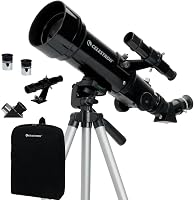
Celestron AstroMaster 70AZ: Best for day and night use

- 70mm achromatic refractor
- 900mm focal length
- 45x and 90x eyepieces
- Altazimuth mount with panhandle
The long 900mm tube delivers steady planet views and an upright image, so the same scope works for wildlife by day and Jupiter by night.
Pros
- Long focal length suits planet viewing
- Upright image for daytime use
- Smooth panhandle mount
Cons
- Heavier at 10.8 lb
- No Barlow lens in the box
Celestron's AstroMaster 70AZ suits a household that wants one scope for both daytime wildlife and night-sky planets. The 900mm focal length is the longest among the refractors here, so planet views hold up well at moderate magnification.
Two eyepieces give 45x and 90x, and the achromatic lens reduces color fringing on bright targets. The panhandle mount makes it smooth to follow Jupiter as the planet drifts.
An erect image diagonal means you can also use it by day without the view being reversed. The StarPointer red dot finder gets you on target quickly.
It weighs 10.8 lb, so it's more of a two-handed carry than the ToyerBee. There's no Barlow in the box, so you'll stay at 90x unless you add one.
At 90x, Jupiter's two main belts and the moons are clear on a steady night. The adjustable full-height tripod works standing or seated, and a free astronomy software download comes with it.
The trade-off against the smaller refractors is weight. Pick it if you want a dual-purpose scope with a long tube and a smooth mount.
MEEZAA 90mm Refractor: Best for sharp wide views

- 90mm aperture
- 800mm focal length
- 32x to 240x with 3x Barlow
- Fully multi-coated optics
A 90mm lens with a 800mm tube gives brighter planet views than the 70mm scopes, and the 3x Barlow pushes magnification to 240x.
Pros
- 90mm aperture gathers more light
- Reaches 240x with the Barlow
- Carry bag and phone adapter included
Cons
- 240x is hard to use on most nights
- Heavier than the 70mm refractors
MEEZAA suits the buyer who wants a brighter planet view without the bulk of an equatorial mount. Its 90mm aperture gathers noticeably more light than a 70mm lens, so the cloud belts look richer.
The f/8.88 ratio is a comfortable middle ground for planets and the Moon.
The 800mm focal length gives 32x and 80x with the 25mm and 10mm eyepieces. The 3x Barlow triples those to 96x and 240x.
In practice 240x is a stretch unless the air is very calm, so plan on 80x to 96x for most sessions.
Fully multi-coated glass improves brightness and contrast. The stainless steel tripod adjusts from 28 to 46 inches and an altazimuth mount keeps aiming easy.
A carry bag, phone adapter and zenith mirror are included. MEEZAA says 90 percent of users assemble it in 10 minutes.
The trade-off against the long-tube Celestron is a shorter focal length for its aperture. That makes it a bit less steady on magnification, but brighter overall.
Pick it if light gathering matters more than a long tube.
Celticbird 80mm Refractor: Best for travel and camping

- 80mm aperture
- 600mm focal length
- 30x and 66x eyepieces
- Backpack and moon filter
An 80mm tube with a backpack, so you can carry it to a dark campsite and set up Jupiter away from porch lights.
Pros
- Backpack makes it easy to carry
- Moon filter included
- Light 5.8 lb kit
Cons
- Stops at 66x without a Barlow
- No Barlow lens in the box
Celticbird suits the camper or traveler who wants to see Jupiter from a dark site. The kit packs into a backpack, so you can carry the 80mm tube, tripod and accessories to a spot away from city lights.
The whole kit weighs 5.8 lb.
The 80mm aperture sits between the 70mm and 90mm scopes. Its 600mm focal length gives 30x and 66x with the 20mm and 9mm eyepieces.
Those settings show Jupiter as a small disc and make the four moons easy to spot. The 3.4 degree field of view gives a generous view for finding the planet.
A moon filter comes in the box. It dims the Moon rather than Jupiter, so keep it for lunar nights.
The altazimuth mount and 5x24 finderscope keep setup simple, and the aluminum tripod adjusts from 17.7 to 52 inches. No tools are needed.
The trade-off is magnification. With no Barlow included, 66x is the top setting unless you add one, so cloud detail stays modest.
Pick it if portability and a dark camping sky matter more than high magnification.
Celestron PowerSeeker 127EQ: Best for tracking on a budget

- 127mm Newtonian reflector
- 1000mm focal length
- German equatorial mount
- 20mm and 4mm eyepieces plus 3x Barlow
A 127mm reflector on a German equatorial mount, so it gathers plenty of light and lets you follow Jupiter smoothly as it moves.
Pros
- 127mm aperture for bright planet views
- Equatorial mount tracks Jupiter
- Barlow triples both eyepieces
Cons
- Needs polar alignment to track well
- Heavier 13 lb tube and mount
Celestron's PowerSeeker 127EQ suits the buyer who wants a reflector's light grasp and a mount that tracks. The 127mm aperture gathers enough light to make Jupiter bright and its belts distinct.
The Newtonian design also avoids the color fringing that refractors show on bright targets.
Its 1000mm focal length gives 50x with the 20mm eyepiece and 250x with the 4mm. The 3x Barlow triples both, so you have wide and high options.
The German equatorial mount with a slow-motion altitude rod lets you follow the planet as it moves. The 5.08mm exit pupil keeps the low-power view bright.
It weighs about 13 lb and needs polar alignment to track well. That's the trade-off against the simpler altazimuth scopes here.
The mirror coating uses aluminum and SiO2 for durable reflectivity. Once aligned, the long tube and large mirror make watching a moon's shadow cross the planet much easier.
Pick it if you want tracking and aperture and don't mind a heavier, more involved setup.
Hawkko 90mm Refractor: Best for stable altazimuth viewing
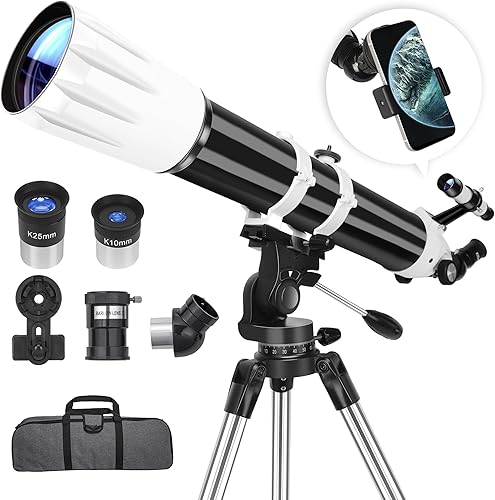
- 90mm aperture
- 900mm focal length
- 36x to 270x with 3x Barlow
- Stainless steel tripod
A long 900mm tube on a stainless steel tripod gives steady views of Jupiter's banding and its moons without an equatorial setup.
Pros
- Stainless steel tripod steadies the view
- Long 900mm focal length
- Carry bag and phone adapter included
Cons
- 270x magnification is beyond most nights
- Heavier tripod than the small refractors
Hawkko suits the observer who wants a long tube on a very steady base. Its 900mm focal length pairs with a 90mm aperture to give crisp planet views at moderate power.
The stainless steel tripod steadies the view better than lighter aluminum legs. That matters for Jupiter, where a tiny wobble blurs the cloud bands.
The 25mm and 10mm eyepieces give 36x and 90x, and the 3x Barlow pushes to 270x. The mount rotates a full 360 degrees and the tripod adjusts from 28 to 46 inches.
In practice 270x is beyond most nights. Stay near 90x to 135x to keep the view sharp.
The kit includes a carry bag, phone adapter, finder scope, zenith mirror and accessory tray. Hawkko says the full multi-layer coating lifts light transmission by about 73 percent.
The trade-off against the top picks is the heavier tripod and the lower score. Pick it if a rock-steady altazimuth setup matters more than saving weight.
How these telescopes compare for Jupiter viewing
The table lines up the specs that decide how well each scope shows Jupiter. Aperture drives light and detail, focal length drives magnification per eyepiece, and the mount decides how easily you follow the planet.
| Product | Best for | Aperture | Focal length | Mount | Our score |
|---|---|---|---|---|---|
| ToyerBee Telescope for Adults & Kids | most beginners | 70mm | 300mm | Altazimuth | 8.9 |
| Dianfan 150EQ Professional Astronomy Telescope | detail and tracking | 150mm | 650mm | Equatorial | 8.5 |
| Bushnell Refractor 600x50mm Telescope | simple grab-and-go sessions | 50mm | 600mm | Altazimuth | 8.1 |
| Celestron AstroMaster 70AZ | day and night use | 70mm | 900mm | Altazimuth | 7.9 |
| MEEZAA 90mm Refractor | sharp wide views | 90mm | 800mm | Altazimuth | 7.7 |
| Celticbird 80mm Refractor | travel and camping | 80mm | 600mm | Altazimuth | 7.1 |
| Celestron PowerSeeker 127EQ | tracking on a budget | 127mm | 1000mm | Equatorial | 7.0 |
| Hawkko 90mm Refractor | stable altazimuth viewing | 90mm | 900mm | Altazimuth | 6.9 |
The Dawes limit figures tell a similar story. The Dianfan's 0.77 arc seconds and the PowerSeeker's 0.91 are the sharpest resolution numbers here, while the AstroMaster's 1.66 arc seconds reflects its smaller lens.
Lower numbers mean finer detail is theoretically possible when the air allows it.
How we chose these telescopes
We started with the specs that matter for Jupiter: aperture, focal length, mount type and the eyepieces in the box. A 70mm lens shows the two main belts on a steady night, while a 90mm or 127mm lens shows more banding and makes the Great Red Spot easier to catch.
We also weighed how each scope handles. An altazimuth mount is quick to aim but needs nudging to follow the planet.
A German equatorial mount tracks once aligned but takes longer to set up and needs polar alignment. The Dianfan and PowerSeeker fall in that second group.
Portability decided the rest. Jupiter sits low for much of the year in many places, so a scope you'll carry outside easily gets used more than a heavy one that stays in a closet.
The 3.5 lb ToyerBee and 5.8 lb Celticbird kit score well on that test, while the 14 kg Dianfan kit and the 13 lb PowerSeeker ask more of you.
What aperture do you need to see Jupiter's cloud bands?
A 70mm scope shows Jupiter's two main belts on a calm night, and 90mm or larger reveals finer banding and the Great Red Spot more often. Aperture is the single biggest factor in how much detail you'll see.
Under 70mm: bright disc and moons only
A 50mm scope like the Bushnell shows Jupiter as a bright disc with its four Galilean moons beside it. Cloud bands are faint at this size.
It's a good first scope for someone who wants to see the planet and its moons without spending much.
70mm to 80mm: the beginner sweet spot
A 70mm or 80mm refractor hits the balance most people want. The ToyerBee, Celestron AstroMaster and Celticbird sit here.
You'll see the two main belts and all four moons on a steady night, and the scopes stay light enough to carry easily.
90mm and up: more banding and the Great Red Spot
A 90mm or larger scope gathers more light, so the belts look richer and the Great Red Spot shows more often. The MEEZAA and Hawkko are 90mm, the PowerSeeker is 127mm and the Dianfan is 150mm.
These need a steady night to show their best. The reflector designs among them also dodge the color fringing that can soften a refractor's view of a bright planet.
Which mount is best for tracking Jupiter?
An altazimuth mount is easiest to aim and best for quick sessions, while a German equatorial mount tracks the planet without nudging and suits longer viewing. Pick based on how long you plan to watch.
Altazimuth: simple to aim, nudge to follow
Altazimuth mounts move up, down and sideways. They're intuitive and quick to set up.
Jupiter drifts out of the view as the Earth turns, so you nudge the scope every minute or so. Most beginners start here, and the ToyerBee, Celestron AstroMaster, MEEZAA, Celticbird and Hawkko all use this mount.
The AstroMaster's panhandle and the Hawkko's full 360 degree rotation make the nudging smoother than a bare mount.
German equatorial: track once, watch longer
A German equatorial mount aligns with the Earth's axis, so turning one slow-motion cable follows Jupiter across the sky. The Dianfan and PowerSeeker use this design.
Setup takes longer and needs polar alignment, but a long session watching a moon cross the planet is smoother. A steady steel tripod, as on the Dianfan and Hawkko, also cuts vibration during the wait.
How much magnification do you need for Jupiter?
Around 50x to 130x shows Jupiter well on most nights. Higher settings magnify atmospheric blur, so use them only when the air is very steady.
Jupiter's useful magnification depends on the aperture. A rough guide is about 2x per millimeter of aperture on a steady night.
That means a 70mm scope tops out near 140x, while a 150mm scope can push past 250x when conditions allow.
Start with a low-power eyepiece to find the planet. Then raise magnification until the image starts to soften.
Backing off one step gives the sharpest view. A 20mm or 25mm eyepiece at 15x to 32x is a good starting point on the scopes here.
Does light pollution affect seeing Jupiter?
No, light pollution barely affects Jupiter, because the planet is bright and close. You can see it from a city balcony on a clear night.
What light pollution does affect is your ability to find it and to spot nearby faint stars.
For help planning a session in town, see our guide on whether you can use a telescope in the city. A dark site still helps when you want to hunt fainter targets after Jupiter, and the Celticbird's backpack kit makes that trip easier to pack.
What else can these telescopes show?
All the picks here go beyond Jupiter. A 70mm scope shows Saturn's rings, the Moon's craters and bright star clusters.
Our guide on what you can see with a 70mm telescope covers those targets in more depth.
The larger scopes open up more. The Dianfan 150EQ and PowerSeeker 127EQ gather enough light for the Orion Nebula and many galaxies.
Smaller refractors handle the Moon and planets well, and they double as daytime spotters for wildlife and landmarks. The AstroMaster's erect image diagonal and the Bushnell's camera mount both help with daytime use.
If you want to branch out to the innermost planet, our walkthrough on Mercury through a telescope explains why it's a tougher target than Jupiter and how to time it.
The best telescope to see Jupiter for your setup
For most people, the best telescope to see Jupiter is the ToyerBee 70mm refractor. It's light, reaches 150x with its Barlow and includes everything you need to start.
Pick the Dianfan 150EQ if you want the largest aperture and a tracking mount. Choose the Celestron AstroMaster 70AZ for a dual-purpose day and night scope.
For travel, the Celticbird's backpack kit is the easiest to carry to a dark site. And if a steady altazimuth base is your priority, the Hawkko's stainless steel tripod delivers. <<<POST
Our top 3 picks at a glance
-
1
-
2
Best for detail and tracking
Dianfan 150EQ Professional Astronomy Telescope
8.5/10 our score
See it on Amazon -
3
Best for simple grab-and-go sessions
Bushnell Refractor 600x50mm Telescope
8.1/10 our score
See it on Amazon
Frequently asked questions
Can I see Jupiter's moons with a small telescope?
Yes. Even a 50mm refractor shows the four Galilean moons as tiny points of light beside the planet.
A 70mm scope makes them easier to spot, and the moons look brightest when they are farthest from Jupiter's glare.
What magnification is best for seeing Jupiter?
Around 50x to 130x works best on most nights. Higher settings like 240x or 270x magnify blur along with the planet, so only use them when the air is very steady.
Start low and raise the magnification until the image softens.
Do I need a moon filter to view Jupiter?
No. Jupiter is much dimmer than the Moon and rarely needs a filter.
A moon filter dims the view and can hide the cloud bands.
Save it for lunar viewing and see our moon filter for telescope guide for that job.
Why does Jupiter look blurry through my telescope?
Atmospheric turbulence is the usual cause. Heat rising from roofs and pavement wobbles the image, so observe when Jupiter is high in the sky and the air is calm.
Let the telescope cool to outdoor temperature and use a steady tripod to rule out vibration.
When is the best time to observe Jupiter?
Observe when Jupiter is highest in your sky, which usually means around the middle of the night. The planet is brightest and least disturbed by the atmosphere then.
Check a sky app for the rise and set times in your area.